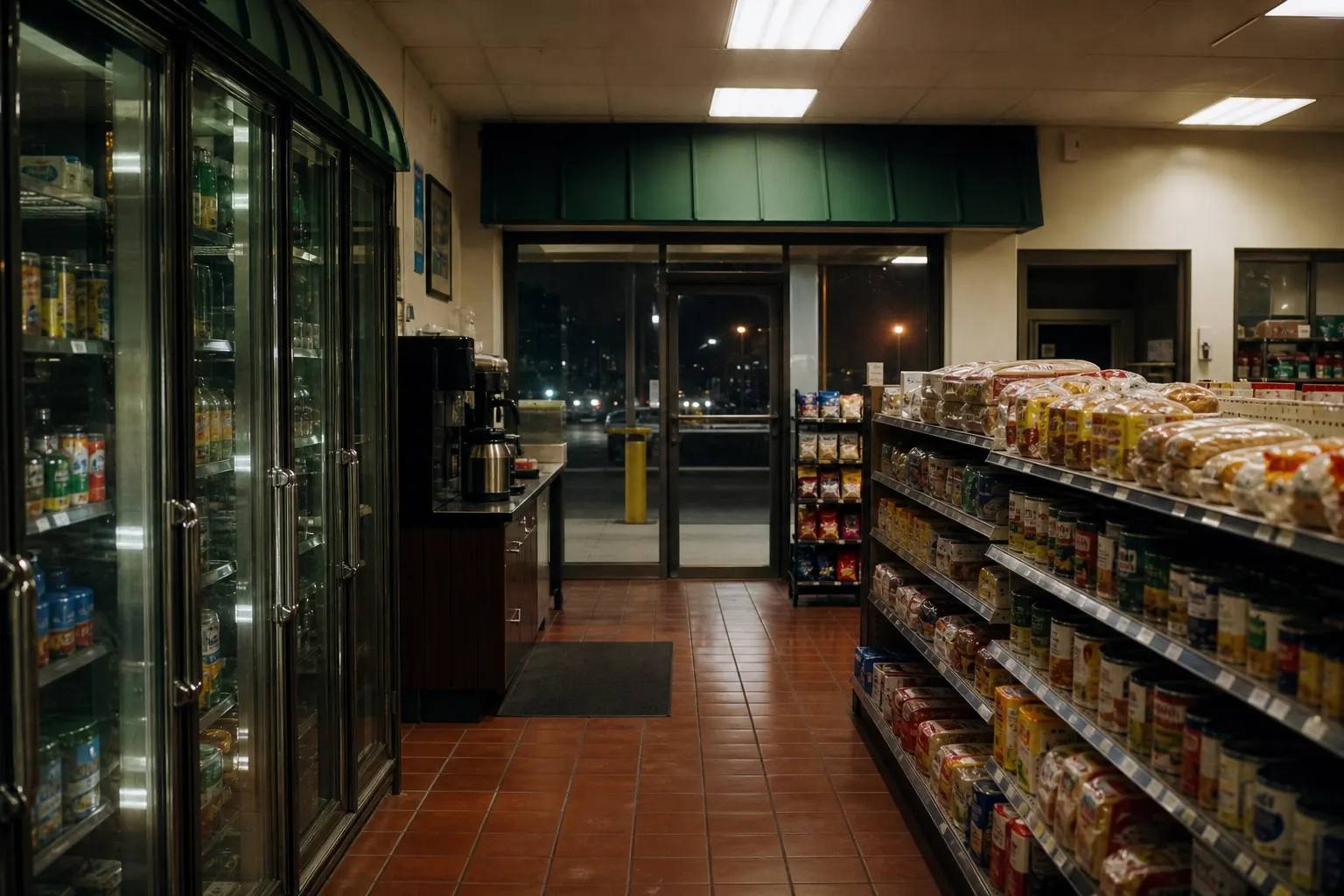
Buying a convenience store with grocery is a mix problem before it is a price problem. The CIM will show a weekly sales number and a photo of a dairy case. You need to know whether you are buying a grocery room that happens to sit next to smokes, or a c-store that hung a few grocery SKUs so the seller could say SNAP. Grocery Store Business Broker — HedgeStone Business Advisors, led by Jason Taken — will not let you underwrite the second as if it were the first. Mark the Buyer Underwriting Workbook, then book a confidential intro with the mix you can actually operate.
Census NAICS 445110 is supermarkets and other grocery retailers except convenience retailers. FMI’s $1 trillion in 2025 supermarket sales, 45,575 U.S. supermarkets in 2024, and $668,377 average weekly sales per supermarket in 2025 describe that channel. They do not describe a 2,400-square-foot box whose earnings sit in cigarettes, packaged beverages, beer, and lottery commission. Quote those figures on this file and you are arguing with the industry’s own definition. FMI’s $19.59 weekly sales per square foot of selling area is the same kind of supermarket benchmark — useful as context, dangerous as a CIM quote.
Walk the grocery room before you price the c-store
Stand in the grocery room and count linear feet that are actually staple foods: bread, milk, eggs, canned goods, rice, frozen vegetables. Then walk the rest of the box. Candy DSD, tobacco, beer, energy drinks, and lottery terminals are the store most c-store operators already know how to run. The grocery room is the part a grocer thinks they are buying. Prove which side pays the note.
A buyer who comes from an independent supermarket will overpay if they treat this as a small supermarket. A buyer who already runs c-stores will underwrite lottery, tobacco turns, and beer-cooler shrink, then ask whether the grocery room is a SNAP accessory or a real department. Both can be honest. Only one of those stories matches any given file. Read how to read a CIM as a list of claims to prove.
Sales proof on this format is category-level or it is a rumor. Weekly totals hide a 70/30 split. You want scan data, sales-tax filings, EBT deposits, tobacco invoices, lottery commission statements, and beer invoices that reconcile. Verifying sales with scan data is the method. A cash story with no bank trail is a walk — see red flags that should kill a grocery deal.
The grocery room should have dating you can defend and a restock path after Monday. Cash-and-carry grocery is common on this format because a full wholesaler drop is too large for the aisle. Confirm you can buy those SKUs without the seller’s personal account. If the grocery room is three bays of dusty cans behind a wall of energy drinks, you are not buying grocery. You are buying a c-store with a compliance display.
Split the P&L the way a lender will
Recast SDE after you split grocery from the rest of inside sales. Evaluating a store’s P&L and anatomy of a grocery P&L assume departments. On this file the departments that matter are grocery, packaged beverage, tobacco, beer, foodservice if any, and lottery commission. One blended gross margin is how a seller hides a grocery room that loses money. Recasting a grocery P&L is the worksheet.
Shrink here is not a supermarket meat-and-produce story. It is cooler theft, employee consumption, dating on the small dairy set, and tobacco that walks. If the seller says shrink is about 2 percent with no count history, assume worse. Shrink, margin, and turns still apply; the clocks are different. Tobacco turns fast. Center-store grocery in a c-store often does not. Inventory turns are not one number.
BizBuySell’s grocery/supermarket sold sample — 3.38 average earnings multiple in 2025; IQR 1.60–3.15 for 2021–2025 — is the wrong ceiling if tobacco, beer, and lottery are the earnings. Use it as national context, then subtract. A 0.43 revenue multiple, the 2025 sold-sample average, is worse here because lottery commission and cigarette cartons inflate the top line. Return to SDE. The valuation hub and multiples report are the sourced method, not a quote you paste onto this fascia.
Teaching example, labeled illustrative: recast SDE of $190,000 after you pull owner add-backs and leave recurring shrink in. If grocery is 18 percent of inside sales, you are not buying a supermarket at 2.5×. You are buying a c-store with a grocery room. Price it the way a c-store operator would, then decide whether that room is worth a premium because it keeps SNAP regulars or a discount because it is a compliance headache. The SDE worksheet is where those four lines belong.
SNAP is a staple-food test on this mix
USDA FNS: SNAP authorization does not transfer. The new owner files a new application for this location. That is federal. A convenience store with grocery does not get a local shortcut. Read EBT / SNAP diligence and what happens to SNAP when you sell. Print the closing and license checklist.
The grocery room exists, on many of these files, because the seller needed staple-food depth to keep authorization. If you reset the mix toward higher-margin snacks after Monday, you can fail the staple-food test the next owner application will face. Budget downtime in cash and in the story you tell regulars. Do not invent a SNAP-household count for the corridor. This pack does not attach those counts.
EBT deposits should reconcile to the SNAP story on the CIM. A gap is mix, downtime, or fiction. SNAP retailer authorization is a new file, not a door sticker you inherit. Write the application clock into the LOI.
Lottery, tobacco, and beer outlast the APA
Lottery retailer contracts are often personal. Confirm assignment or a new contract before you count commission as durable SDE. Tobacco sits with tax and health agencies, not with the APA automatically. Beer and wine are a class, a quota license, or — in a control state — a limited privilege. NABCA lists 17 control states plus local-control pockets. Read alcohol regime and liquor license diligence. Transferring a liquor license is a calendar, not a handshake.
WIC, lottery, and tobacco checklists exist because these three kill more convenience-with-grocery closes than a produce cooler. WIC is a vendor file. If WIC is material, treat it as a close condition. Food permit transfer sits with the local health department. None of those clocks wait for your remodel plan.
Hours you will actually staff
This format often runs 16 to 24 hours. A grocery buyer who wants a 7 a.m. to 8 p.m. neighborhood grocery will not staff the overnight. Insurance, incident logs, and whether you will actually stand those hours belong in the model before you tour. Buying as a first-time owner is honest about perishable skill. Convenience-with-grocery also needs overnight skill, cash-handling skill, and a stomach for the corridor.
Lease diligence still matters: assignment, remaining term, exclusive use, and whether the use clause allows grocery plus tobacco plus beer. Occupancy as a percent of sales — use the rent checker — can look cheap because the box is small and the sales include cartons. Recast rent against inside grocery if you are telling yourself this is a grocery deal. A related-party below-market rent juiced the seller’s earnings and will reverse on day one.
Owned dirt is a second file. Recast the store on market rent, then decide whether to buy the building. That conversation lives on grocery with real estate and buying a store with real estate. Do not blend a cheap lease into a supermarket multiple.
Wage is a model input on a three-shift box. State minimum wage belongs in labor before you fall in love with a corridor. Food-tax treatment changes how you corroborate sales — grocery sales tax.
Cash to close when DSD owns the room
How much money you need is a stack: equity, inventory at cost, working capital for the next DSD and cash-and-carry loads, and SNAP lag. The cash-to-close estimator exists so you stop using the down-payment slogan.
Teaching example, labeled illustrative: a $650,000 going-concern (ex-inventory) at 15 percent equity is $97,500. Tobacco-and-beer inventory at cost of $110,000 is usually cash or a short-term piece. Add $40,000 working capital — the cash to keep DSD and the grocery room stocked — and $20,000 for closing plus SNAP downtime. You are a roughly $267,500 buyer, not a $97,500 buyer. Say the real number on the call.
Inventory night on this format is tobacco, beer, and a grocery room that may be dated. Retail tags are not cost. Unsellable needs rules before 2 a.m. Read how inventory is counted and closing-day count procedures. Candy and snack DSD will keep delivering only if someone is paying them.
SBA 7(a) can finance a change of ownership; the published maximum is $5 million. Eligibility still wants a for-profit U.S. business that is small under SBA size rules, not an ineligible type, and creditworthy with a reasonable ability to repay. A convenience-with-grocery file has to look like a business the program can underwrite. Read SBA 7(a) for grocery acquisitions. DSCR is annual cash flow after an honest recast, divided by annual debt service. Use the SBA payment and DSCR calculator. Unreported cash does not survive SBA.
Seller carry, if any, often sits on standby. Read buying with seller financing. Conventional paper shows up when the box is boring in a good way — conventional and alternative financing.
Who should tour this file
C-store operators and fuel marketers adding a fuel-less box usually win because they already know lottery, tobacco, and overnight labor. Grocers win when the grocery room is real and they will not try to run it like a 20,000-square-foot supermarket. Tourists who want a little grocery store without overnight hours should look at a neighborhood grocery instead.
Compare the twin sell page if you want the seller’s incentives. Gas-station grocery is the sibling with tanks. Discount or salvage is a different working-capital problem. Start from the buyer hub and how to buy a grocery store step by step.
FMI’s 2.1 percent food-retailer net in 2025 is a reminder that food retail is thin. A c-store with a grocery room can print a better or worse number. It is not allowed to hide the grocery room inside a supermarket slogan. The 2.66 five-year average earnings multiple on BizBuySell grocery/supermarket sold businesses is the same kind of national context — not this box’s quote.
Post-close, do not reset the mix for sport in the first 90 days. Keep DSD paid, re-file SNAP immediately, walk dating in the grocery room daily, and hold the seller to transition hours in the APA. Read the post-closing 90-day plan and transition and training periods. Attorneys who have never closed this format will treat lottery as a footnote — bring them working with attorneys and CPAs. Surviving due diligence is the calendar after the LOI.
When the workbook is marked and you can say in one sentence whether you are buying a grocery room or a c-store, schedule the buyer strategy call. Bring proof of funds, the hours you will staff, and the states you will occupy. Jason Taken would rather recast the mix on that hour than tour you through a box you will not stand overnight.
Worked math for Buy a convenience store with grocery
Use this napkin recast on Buy a convenience store with grocery when you book the call. It is labeled illustrative. BizBuySell's 2025 grocery sold-business earnings multiple averaged 3.38, with a 2021-2025 IQR of 1.60-3.15.
If weekly sales or shrink move 8 percent, the SDE and the note move with them. That is why Jason Taken starts with scan data and the lease, not with a neighbor's rumor multiple.
Bring proof of funds or a lender pre-screen, your format, and geography. Jason will tell you whether a store like this can clear SBA or seller-carry math.
This page is educational information from Grocery Store Business Broker (HedgeStone Business Advisors). It is not legal, tax, or investment advice. Licensing, tax, and financing rules vary by state and deal. Confirm every item with counsel and your lender before you sign.