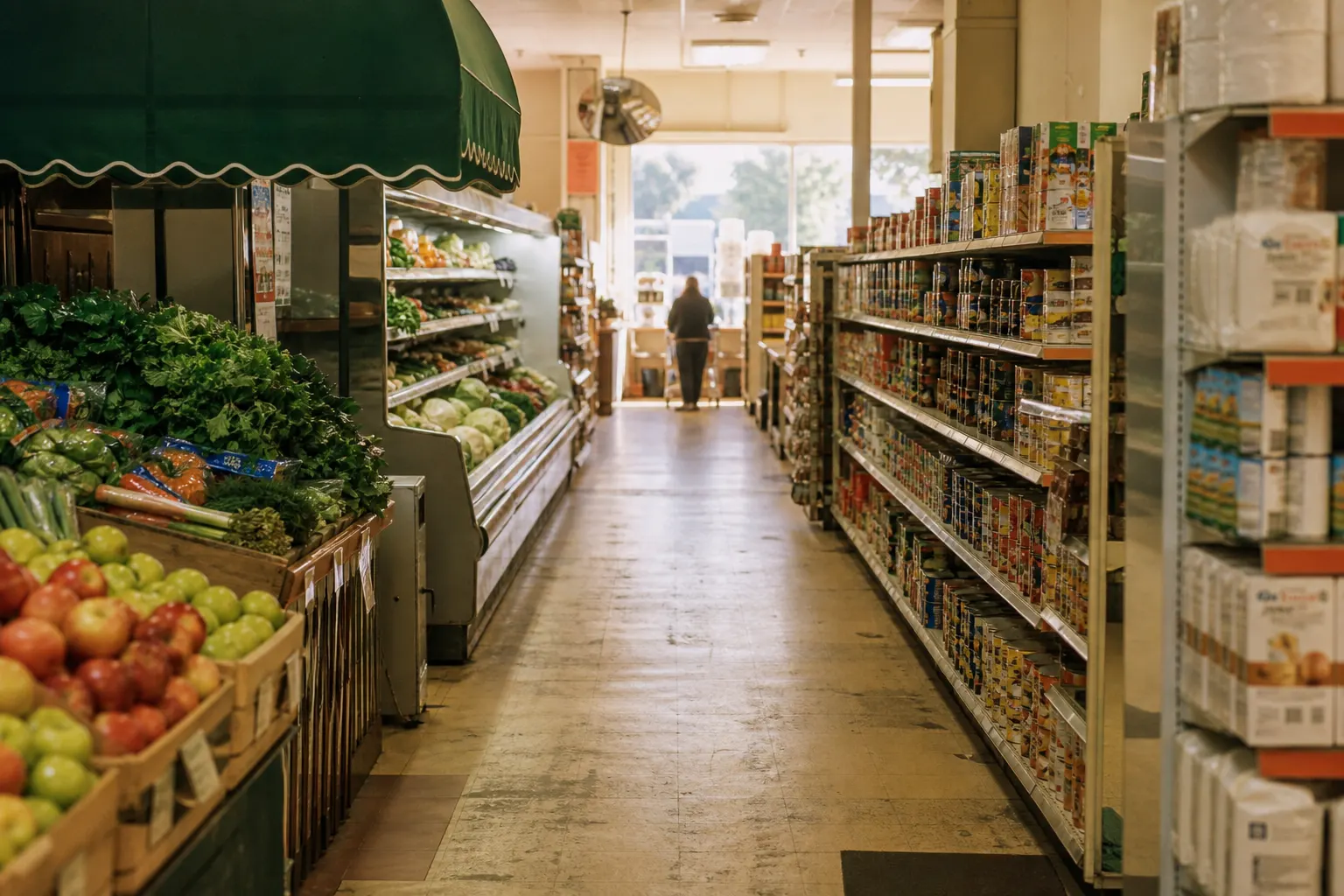
Independents trade on recast SDE. Chain grocery M&A is a different sport. Do not mix the multiples. Grocery Store Business Broker — the grocery practice of HedgeStone Business Advisors, led by Jason Taken — packages one-store and small multi-store files for operators who can fund them. If you came here because a newspaper said grocery is consolidating, keep reading. The consolidation story is real as weather. It is not your asking price.
FMI sized supermarket sales at $1 trillion in 2025 and counted 45,575 U.S. supermarkets in 2024. $668,377 average weekly sales per supermarket and $19.59 weekly sales per square foot are channel samples. They describe the supermarket industry, not the check on a 12,000-square-foot independent. Use them as context on the industry outlook. Price the file you can prove. Start at the seller hub or the buyer hub for the sequence. This page is who buys whom, and on which number.
Two markets that share a word
When people say “grocery M&A,” they usually mean one of two rooms. In the first room, a public or large private banner buys another banner, a warehouse, or a cluster of stores to take cost out of a circular, a private-label plant, or a lease portfolio. Those deals talk EBITDA, synergy, and sometimes a stock-for-stock story. You will not see the diligence stack from that room in a one-store CIM.
In the second room, an owner-operator sells a going concern. The buyer is another independent, a manager with a seller note, or an SBA 7(a) borrower who already knows a meat case. The number is recast SDE plus inventory at cost. The clocks are the lease, SNAP, alcohol, and the warehouse. That is the room this site lives in.
Mixing the rooms is how a seller quotes a chain headline and then sits through six months of operator offers that look “low.” Mixing the rooms is how a first-time buyer underwrites a neighborhood box as if a strategic will rescue the rent. Read SDE versus EBITDA before you pick a trophy print. A two-store independent with a hired general manager can be discussed on EBITDA. A single owner working 70 hours is an SDE file. Subtract a market-rate manager if the buyer will not work those hours.
This pack does not invent chain-deal dollars or a format-specific strategic multiple. If a banker waves a supermarket-chain print at your independent, ask them to recast this P&L. Then apply the only transaction multiple set sourced here.
The only sold-sample multiples in this pack
BizBuySell grocery and supermarket businesses sold on that listing site: 3.38 average earnings multiple in 2025; 2.66 five-year average; sold-business earnings IQR 1.60–3.15 for 2021–2025. The 2025 sold sample also printed a 0.43 average revenue multiple. Those figures are a national listing-site sample. They are not an independent-only table. They are not a chain M&A print.
Use the earnings IQR as a ceiling check and a sanity band. Banner transferability, remaining lease term, and license lag move the check more than a sentence about “the M&A market.” A 0.43 revenue multiple hides rent and labor. Use it to see whether a headline is silly, then return to SDE. Read the multiples report and how to value a grocery store.
A teaching file — not a quote. Recast SDE of $240,000. Inventory at cost of $210,000. A 2.2× going-concern line is $528,000 before stock. A 3.0× line is $720,000 before stock. If the lease has 18 months and no options, you are not in the high end because a chain somewhere paid a strategic number. If the wholesaler over-advance is still on the seller’s guarantee, you are not in the high end either. See wholesaler agreements at sale.
Compare offers on cash at close, note terms, inventory treatment, and license risk. The headline price is the least interesting line. Read comparing offers. Earn-outs are hard because the buyer controls mix after Monday. Holdbacks exist because grocery has shrink and successor tax risk. Write both into the LOI.
Who actually shows up for an independent
The buyer pool for a full-line independent supermarket is specific. Multi-store independents adding a box. Owner-operators exiting a smaller neighborhood grocery. SBA 7(a) first-time buyers who already have grocery experience. That last group needs a file a lender will fund. SBA 7(a) can finance a change of ownership. The published maximum is $5 million. A supermarket-sized independent plus inventory can press that ceiling. Read SBA 7(a) for grocery and how much money you need.
Strategic chain buyers are rare on a single neighborhood file. They already have real estate committees, banner rules, and a warehouse map. They do not need your 8,000-square-foot box unless it sits on dirt they want or fills a hole their circular cannot reach. Do not build a process around a bidder who is not in the room. Confidential operator outreach is the default. Read how to sell confidentially. The blind teaser exists so the floor does not hear first.
A sale to a family member or a manager still needs a real price and a real note. Soft language creates hard lawsuits. See selling to family or an employee. Lifestyle buyers who want a “nice grocery” without a recast will not survive DSCR. Hope is not a ratio. Labor still moves with the state minimum-wage table, not with a synergy model.
If you own the dirt, recast the store on market rent, then price the building as a second asset. A cheap cap rate on the land does not fix a store that cannot staff produce. Read selling with a lease versus real estate and buying a store with real estate. A sale-leaseback can unlock owned real estate without pretending the store and the land are one M&A number.
Rural files have a buyer pool measured in single digits. That is not a license to invent a scarcity premium. See sell a rural grocery. Ethnic and specialty files have operator-specific buyers. Language on the floor is part of the asset. See buying an ethnic market outside your community.
Multi-store packages still fail store by store
Two or four independents under one owner is not a chain deal. It is a shared recast and a shared license calendar, or it unravels location by location. SNAP is a new-owner application at each FNS file. Alcohol is a class, a quota, or a control-state product at each address. The warehouse may treat each store as a drop, or it may treat the package as one book with one over-advance. Read selling multiple locations before you staple four P&Ls and call it a landscape.
A buyer who wants only two of four boxes is a real offer. Price the leftover stores as leftover stores. Do not force a package premium this pack does not source. Transition hours, non-competes, and WARN calendars get harder as headcount grows. See employees, unions, and WARN.
DSD vendors will keep delivering after a sloppy close only if someone is paying them. Sequence vendor notice after an NDA and a serious buyer. Telling the warehouse first is how the floor hears you are exiting. The wholesaler directory and banner directory are orientation. Your statements are the file.
The consent stack that decides whether a landscape becomes a close
USDA FNS: SNAP authorization does not transfer. The new owner files a new application. A strategic buyer does not get a shortcut. Budget downtime in cash. Read SNAP when you sell. EBT deposits should reconcile to the SNAP story. A gap is mix, downtime, or fiction.
Alcohol still sits with the state. NABCA lists 17 control states. “The liquor license” is never one magical asset. Read liquor diligence. WIC, lottery, and tobacco have their own clocks. Print the closing and license checklist.
A lease with 24 months or less and no options is a price cut. Assignment, exclusive use, and co-tenancy still surprise civilians who have been reading chain-deal coverage. Read lease diligence. CAM true-ups can erase a year of “extra” SDE.
Most independents still close as asset sales. You are selling listed assets, not a promise that the entity’s history disappears. A stock sale shows up when a quota license is painful to move. Read asset sale versus stock sale. Tax clearance belongs in escrow. Bulk-sale practice can still exist after UCC Article 6 died. See state bulk-sales notes.
Unreported cash does not survive SBA and does not survive a serious conventional buyer. It is a disqualifier in both rooms. See selling with unreported cash. Distressed stores still have inventory and a lease. Price those, not a turnaround novel. See selling a distressed grocery and buying a distressed store.
FMI’s 2.1 percent average net profit for food retailers in 2025 is a Speaks sample. It is not a synergy model. Independents live on shrink, rent, and the next drop. Recurring shrink is not an add-back you keep because “M&A is hot.”
Outreach is a process, not a press cycle
Chain grocery headlines do not fill your buyer list. Operator outreach does. Build a short universe: independents already in the warehouse book, owners one format smaller who want a bigger box, and financed buyers who can show grocery hours. Sequence it under NDA. A vestibule sign is a last resort. Read how to sell confidentially and how brokers get paid so you know what a process costs in time.
Buyers should run the same filter in reverse. If the CIM reads like a strategic teaser — synergy language, no lease abstract, no SNAP plan — you are in the wrong room. Read how to buy a grocery store and how to read a CIM. Due diligence on an independent is scan, warehouse statements, and license clocks, not a Hart-Scott story.
Inventory still counts at cost on count night. FIFO versus a messy room is how operator deals blow up after the “landscape” conversation is over. Read how inventory is counted. Transition hours are a close condition. Write them. See transition and training. The first 90 days are vendor trust and not changing the mix for sport — post-closing 90-day plan.
Do not wait for a better M&A tape. Wait for a recast, a lease with years on it, and a warehouse the buyer can join. Newspaper cycles do not pay the first drop.
What to bring if you want this applied to your file
Say in one sentence which room you are in. One store. A small package. A building you want to keep. A note you are willing to carry. Then say what you do not have: tax returns, scan data, a written lease, or a SNAP history. Missing paper is common. Hiding it is how the hour dies.
Print the SDE worksheet. Mark owner pay, one-time repairs, and related-party rent. Bring the wholesaler page with any over-advance circled. Bring the lease page with the assignment clause underlined. The Confidential Seller Playbook is the longer mark-up. Buyers should also read how to buy a grocery store and how to read a CIM.
Jason Taken will recast the landscape in that order: which market you are actually in, weekly sales you can prove, SDE or EBITDA a lender will believe, inventory at cost, then the consent stack. The valuation calculator lets you change inputs yourself. The hour is for whether those inputs are real.
Book a confidential intro. Bring last week’s scan if that is all you have. Operator outreach starts after the recast, not after a chain headline.
An illustrative recast on Grocery M&A Landscape
Price language for Grocery M&A Landscape is (recast SDE x a defendable multiple) + inventory at cost, plus or minus lease and license risk. The table is one consistent example for this URL.
Inventory is cash at close, not a multiple. Confusing the two is how sellers over-ask and buyers under-cash the wire.
Book the intro call with your side of the table ready: seller files or buyer capital. The calendar is the only next step.
This page is educational information from Grocery Store Business Broker (HedgeStone Business Advisors). It is not legal, tax, or investment advice. Licensing, tax, and financing rules vary by state and deal. Confirm every item with counsel and your lender before you sign.