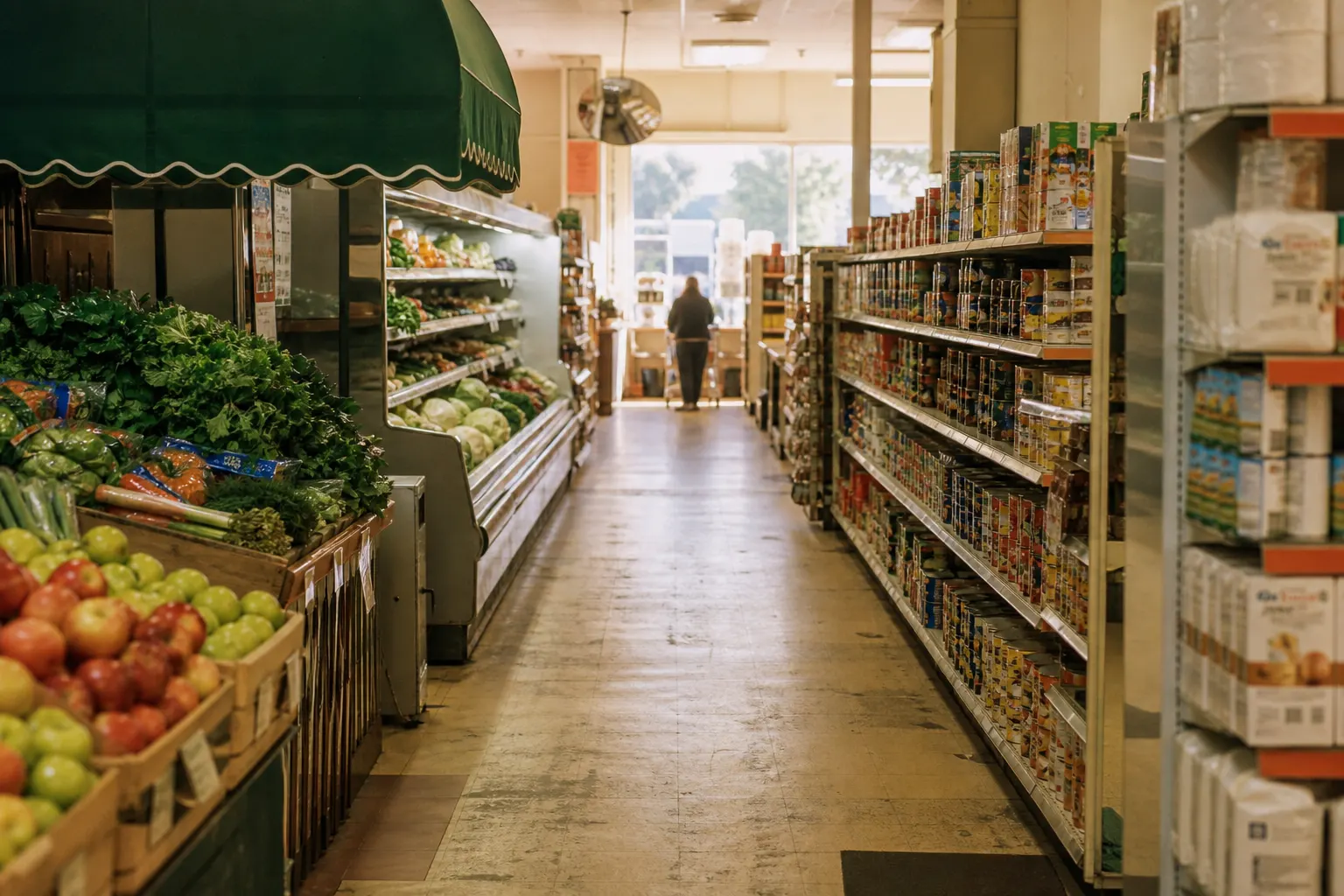
Generated illustration for this page. Not a listed store and not a photograph of a specific owner.
Successor liability — The risk that a buyer of grocery assets still inherits the seller’s unpaid sales tax, wage claims, or other debts. Tax agencies are the usual grocery worry. Employment and environmental claims can follow the facts of the transfer even when the APA says the buyer takes no liabilities.
Ask for the last filings before you argue price. Grocery Store Business Broker — HedgeStone Business Advisors, led by Jason Taken — treats this as a cash-and-notice problem, not a vocabulary word in the CIM. Book a confidential intro when you have tax transcripts and a draft escrow hold, not a hope that “it was an asset deal.”
Sales tax that follows the box
Grocery sells a mixed basket. Some SKUs are taxable, some are not, and the mix changes by state. A seller who under-collected, under-filed, or never closed a period leaves a bill that agencies are good at finding. Buying the cooler and the scanner does not always put you outside that bill. Bulk-sales practice and tax clearance exist because UCC Article 6 died in most places and the tax departments did not.
What is a bulk sales law is the short reading. State-by-state bulk sales and tax clearance is the map. Do not invent a rule for a state you have not checked. Do write the notice or clearance process into the close calendar so the agency is not discovering the sale from a new owner’s first return.
A stock sale is simpler in a grim way: you bought the taxpayer. There is no doctrine to argue. There is only diligence and a holdback.
Escrow, notice, and clearance
Hope is not a process. The process is notice to the agency when the state requires it, a clearance letter when the state issues one, and dollars that stay in escrow until the letter arrives or the claim period runs. A warranty that the seller “has paid all taxes” without cash behind it is a paragraph you will read again in a demand letter.
Size the hold to the risk you can see: open periods, a messy mixed-food filing, a recent audit. Do not invent a percentage of SDE as a statistic. Inventing a formula is how files under-hold and then argue. Escrow, holdbacks, and earn-outs is the mechanics essay. This page is why grocery uses those mechanics.
Sales-tax filings are also a sales corroboration tool where food is taxed or partially taxed. A gap between the P&L and the returns is either mix, downtime, or fiction — and it is the same gap an agency will read.
Wage and environmental facts that survive an APA
A buyer who keeps the crew can inherit more than good will. Unpaid wages, unpaid PTO, and a UFCW contract with successor language are employment facts, not fixture facts. What happens to employees when you sell is the people question. WARN is the headcount calendar on larger files.
Old tanks, a leaking compressor room, and a loading-dock stain the landlord already knows about are environmental facts. An asset schedule that omits them does not make them the seller’s problem if the buyer is the operator standing on the stain. Walk the box. Ask. Put known items in the APA instead of discovering them with a health inspector.
If the file has open tax periods or a union shop, bring the transcripts and the contract. Book the liability conversation. The hour is for what still follows you after Monday.
Worked math for Successor liability on a grocery buy
These figures are a teaching walk-through for Successor liability on a grocery buy, not a quote and not a sold comp. Order of operations: weekly sales, recast SDE, inventory at cost, then a multiple band.
Input or output
Illustrative figure
Weekly sales (illustrative)
$108,000
Annual sales
$5,616,000
Recast SDE
$174,096 (3.1% of sales)
Inventory at cost
$468,000 (~12 turns)
Occupancy check
$134,784 / year (2.4% of sales)
Low going-concern
$763,963 at 1.70x SDE + inventory
High going-concern
$1,016,402 at 3.15x SDE + inventory
Sketch DSCR on a note
1.38
If weekly sales or shrink move 8 percent, the SDE and the note move with them. That is why Jason Taken starts with scan data and the lease, not with a neighbor's rumor multiple.
Book the intro call with your side of the table ready: seller files or buyer capital. The calendar is the only next step.
Download the worksheets, then book the call
Print these, mark them up, and bring the marked copy to the intro. They are educational. They are not a valuation letter and not a listing.
All downloadable guides.
Confidential Seller Playbook3 pages. Recast checklist, teaser rules, license calendar, and what to bring to the first call.
Buyer Underwriting Workbook3 pages. Sales proof, shrink, rent, SNAP, DSCR, and cash-to-close math a lender will fund.
SDE Valuation Worksheet2 pages. Line-by-line add-backs, inventory at cost, and a multiple band you can defend.
Closing & License Checklist2 pages. Count night, SNAP re-application, alcohol, tax clearance, and the first 30 days.
Frequently asked questions about Successor liability on a grocery buy
If I only buy fixtures, can a tax agency still chase me?
In many states, yes, if the notice or clearance process was skipped. Grocery sells taxable mix. Unpaid sales tax is the claim buyers discover after the first recon. Counsel owns the statute; the file still needs a process.
Does an asset sale wipe wage claims automatically?
Not always. Employment claims can follow the workforce and the facts of the transfer even when the APA says the buyer takes no liabilities. Read the shop, the CBA, and the payroll history.
What actually reduces this risk on a grocery close?
A tax-clearance letter or bulk-sale notice, dollars in escrow, and a holdback that survives the first filings. A warranty in the APA without cash behind it is a paragraph, not protection.
Is successor liability only a stock-sale problem?
No. Stock buyers already own the taxpayer. Asset buyers still face agency and employment theories. Treat both structures as if someone will look for a deep pocket after Monday.
Start a confidential grocery conversation
Whether you are exiting or acquiring, pick a time and we will talk through the file.
SBA 7(a) loans — U.S. Small Business Administration, accessed 2026-09-03.
This page is educational information from Grocery Store Business Broker (HedgeStone Business Advisors). It is not legal, tax, or investment advice. Licensing, tax, and financing rules vary by state and deal. Confirm every item with counsel and your lender before you sign.
Ready when you are. Jason Taken will talk through the file.