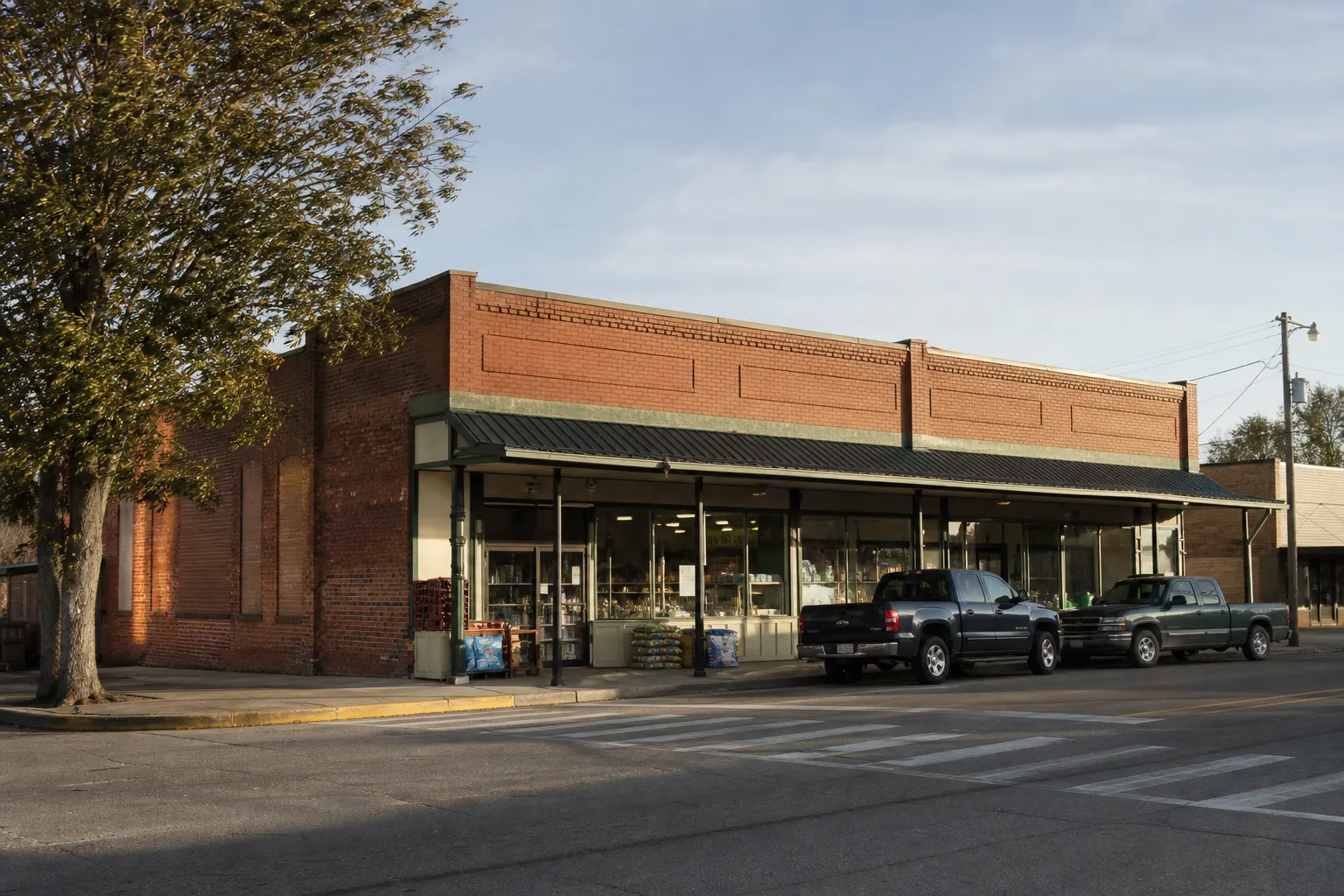
A rural grocery can be a good living and a difficult loan. Those are different questions. Grocery Store Business Broker — the grocery practice of HedgeStone Business Advisors, led by Jason Taken — packages the file so a manager, a neighboring independent, or a financed buyer can actually close. Start at the seller hub for the whole sequence. This page is the one-store town.
FMI published $1 trillion in 2025 supermarket sales and counted 45,575 U.S. supermarkets in 2024. The $668,377 average weekly sales per supermarket in 2025 is the wrong benchmark for a rural box. So is $19.59 weekly sales per square foot. Those figures describe the supermarket channel. Your freight, your drop minimum, and your next announced dollar store are the story.
The only store in town still needs a file
One store. High community dependence. A buyer pool measured in single digits. Fragile wholesaler minimums. If there is a pharmacy counter, its loss is a separate story. FMI’s 2.1 percent average net profit for food retailers in 2025 is a food-retailer sample. It will not price a town that drives 28 miles when you close.
Food-desert rhetoric does not replace a P&L. Do not invent a scarcity premium because the next store is far. Inventory at cost and the condition of the lease or the building are most of the check. Read buying in a food desert so you know what a mission buyer will still demand. The Healthy Food Financing Initiative and state healthy-food programs change. Do not quote a stale dollar cap.
Suppose a normal week rings $58,000. Annualized sales are $3,016,000. If recast SDE is 5.4 percent after you put owner pay and a personal truck back where they belong, SDE is $162,864. That is a teaching walk, not a quote. Divide annual COGS by the turns that match a long-lead stockroom. Add sellable inventory at cost as a separate line. Then ask whether a lender in this density will fund it.
Related-party rent on a family building will reverse. Pull it out of SDE. Recurring shrink is the business. Read recasting a grocery P&L and mark the SDE worksheet. Scan data still matters when the week is smaller. See verifying sales with scan data.
Drop minimums, long routes, and the IGA lifeline
Most rural boxes live on one primary wholesaler with a drop-size minimum. If that minimum is about to rise, the store’s math changes before the multiple argument starts. Long DSD routes may drop you. Bread and soda that skip a town are empty doors, not a merchandising choice.
A co-op or IGA banner can be a lifeline. Confirm the contract. Program fees belong in the recast if the buyer will keep the fascia. A banner the buyer cannot assume is a rebrand and a warehouse fight. Read wholesaler and banner agreements and banner versus independent. Sequence the warehouse call after an NDA and a serious buyer. Telling the driver first is how the town hears you are selling.
Over-advances are debt. They are not an add-back. Personal guarantees the buyer cannot assume stall rural files as often as they stall city files. See the wholesaler directory for orientation. Your statements are the evidence. Working capital is the cash to hit the next minimum, not a hope that the co-op “wants the town to have a store.”
DSD vendors keep delivering after a sloppy close only if someone is paying them. Put those accounts on an APA schedule. Read APA essentials. Turns on center store and a two-door meat case do not share a clock — shrink, margin, and turns.
Scarcity talk versus inventory and the building
Rural files get priced on a mix of SDE and “this town will not have a store.” That sentence is a community fact. It is not a license to invent a dollar premium. BizBuySell grocery and supermarket sold businesses: 3.38 average earnings multiple in 2025; 2.66 five-year average; IQR 1.60–3.15 for 2021–2025. A 0.43 average revenue multiple on the 2025 sold sample is a sanity check. Those figures are a national listing-site sample. They are not a rural-only multiple.
Inventory quality and the building condition move more money than a scarcity speech. Dated grocery on a long lead time is a count-night fight. A roof, a compressor, and a dirt parking lot are diligence, not atmosphere. Read the valuation hub and how to value a grocery store. The multiples report is the same national sample.
If you own the dirt — common in a small town — recast the store on market rent, then price the real estate as a second asset. Read selling with a lease versus real estate and grocery with real estate. A sale-leaseback can unlock the building without pretending the store and the land are one number.
Compare offers on cash at close, note terms, inventory treatment, and license risk. See comparing offers. DSCR is annual cash flow over annual debt service. Hope is not a ratio. Earn-outs are hard when the buyer controls hours after Monday. Holdbacks exist because shrink and successor tax risk travel with grocery.
Local managers and adjacent-town independents
Who actually buys? Local managers. Independents in the next town adding a box. Mission-driven or HFFI buyers who still need a P&L. That list is short. A blind teaser still matters. The meat cutter and the county inspector talk.
The twin page is buy a rural grocery. Send a serious operator there after the NDA. SBA 7(a) has a $5 million maximum. Rural files often sit under that ceiling and still fail density or experience tests. Seller notes are common for that reason. Read the standby if a note sits behind SBA — seller financing and buying with seller financing.
Unreported cash will not survive SBA or a serious conventional buyer. Read selling with unreported cash. A sale to a family member or the night manager still needs a real price and a real note. See selling to family or an employee. Soft language in a small town creates hard lawsuits among people who share a church.
Mission money does not waive a recast. If an HFFI or state program is part of the buyer’s story, treat it as a funding path that can change, not as a price. See conventional and alternative financing. First-time owners should read buying as a first-time owner.
When SNAP downtime empties the aisle
USDA FNS: SNAP authorization does not transfer. The new owner files a new application. In a one-store town, that gap is existential. Shoppers who cannot use EBT will drive. Plan downtime in cash and in the story you tell the landlord and the mayor. EBT deposits should reconcile to the SNAP story. A gap is mix, downtime, or fiction.
Read what happens to SNAP when you sell and EBT diligence. See SNAP retailer authorization. Print the closing and license checklist. Write the SNAP condition into the LOI before you pick a Tuesday.
Retail food permits reset. Any pharmacy is a separate license and a separate pharmacist. If the owner is also the only butcher or the only pharmacist, the buyer is buying a person. Price that as key-person risk, not as goodwill. Alcohol, if you have it, is a class, a quota, or a control-state product. NABCA lists 17 control states. Read transferring a liquor license and state alcohol regimes.
WIC is a vendor file, not a sticker on the door. Lottery contracts are often personal. Tobacco sits with tax and health agencies. See WIC, lottery, and tobacco checklists. Most rural files close as asset sales. You are selling the going concern, the equipment, and the stockroom. Read asset sale versus stock sale.
Confirm the dollar store; do not invent it
A Dollar General already open or announced is a red flag you confirm. Do not invent a competitor to talk the price down, and do not ignore a store that is already pouring a slab. Read competition analysis and trade-area math. Freight and a new dollar box change mix. They do not create a format-specific sold multiple.
A wholesaler about to raise the drop minimum is the other operational red flag. Get the letter or the verbal in writing after the NDA. The third is the owner who is also the only skilled cutter or pharmacist. Transition hours are not a courtesy in that file. They are the close. Read transition and training and red flags.
Lease remaining term under 24 months without options is a price cut even when you own the dirt through a related entity. Lease diligence still applies. Assignment, exclusive use, and CAM true-ups surprise people who thought a small-town lease was “simple.” Tax clearance belongs in escrow language — state bulk-sales notes. Sales-tax filings corroborate the register where food is taxed — state grocery sales tax.
Non-competes in a small town have to be narrow enough to keep and enforceable in the state. A covenant that covers three counties will not hold. Minimum wage still belongs in the recast — state-by-state minimum wage.
Notes, HFFI talk, and loans that stall
A CIM that omits the wholesaler minimum is a brochure. Three years of P&Ls and returns. Weekly sales. Department mix that admits meat and produce can sink a “healthy” storewide number. Wholesaler statements and any over-advance. A license list that names SNAP as a share of the week, not as a sticker. An honest inventory estimate at cost. Building condition if the dirt conveys. Transition hours the owner will actually work.
Download the Confidential Seller Playbook. Circle the hole. Read how to read a CIM and preparing three years of financials. How to sell confidentially still applies when everyone knows everyone. Employees learn from vendors and shoppers. A vestibule sign is how you empty the stockroom before you have a buyer.
Inventory night needs rules for unsellable, the crew, and disputes. FIFO versus a messy room starts a fight at 2 a.m. in a small town the same as in a city. Read how inventory is counted and closing-day count procedures. The LOI should say how inventory is counted and how licenses are conditioned — LOI terms for sellers.
Counsel who have never closed grocery will rediscover SNAP in week six. Send them working with attorneys and CPAs. Taxes on an asset sale are allocation. Start at taxes on selling a grocery store. Distressed rural files still have inventory and a lease. Price those — selling a distressed grocery. See how it works and the FAQ.
A neighborhood box in a city is a different file — sell a neighborhood grocery. A full-line independent is a different file — sell an independent supermarket. Do not paste this page onto those URLs.
Mark the drop minimum and book the call
Say what you want after close. Cash. A note the next operator can service. The building. A part-time job in the meat case. Then say what you do not have: scan data, a written warehouse contract, or a SNAP history. Bring the downloads you marked. Bring the wholesaler page with the minimum circled. Bring the dollar-store photo if the slab is already there.
Jason Taken will recast a rural grocery in that order: weekly sales you can prove, SDE a lender will believe, inventory and building condition, then SNAP downtime. The twin buyer page is buy a rural grocery. The valuation calculator lets you change inputs. It will not invent a town-specific multiple.
Book a confidential intro. Bring last week’s sales if that is all you have. That is a useful hour.
How a buyer would price Sell a rural / small-town grocery store
Use this napkin recast on Sell a rural / small-town grocery store when you book the call. It is labeled illustrative. BizBuySell's 2025 grocery sold-business earnings multiple averaged 3.38, with a 2021-2025 IQR of 1.60-3.15.
Rent at 2.7% of sales is the occupancy check. If the real lease is higher, the SDE in this table is too generous until you recast to market rent.
Bring three years of P&Ls, weekly sales, and the lease abstract to the intro call. Jason will tell you whether this band is even in the conversation.
This page is educational information from Grocery Store Business Broker (HedgeStone Business Advisors). It is not legal, tax, or investment advice. Licensing, tax, and financing rules vary by state and deal. Confirm every item with counsel and your lender before you sign.