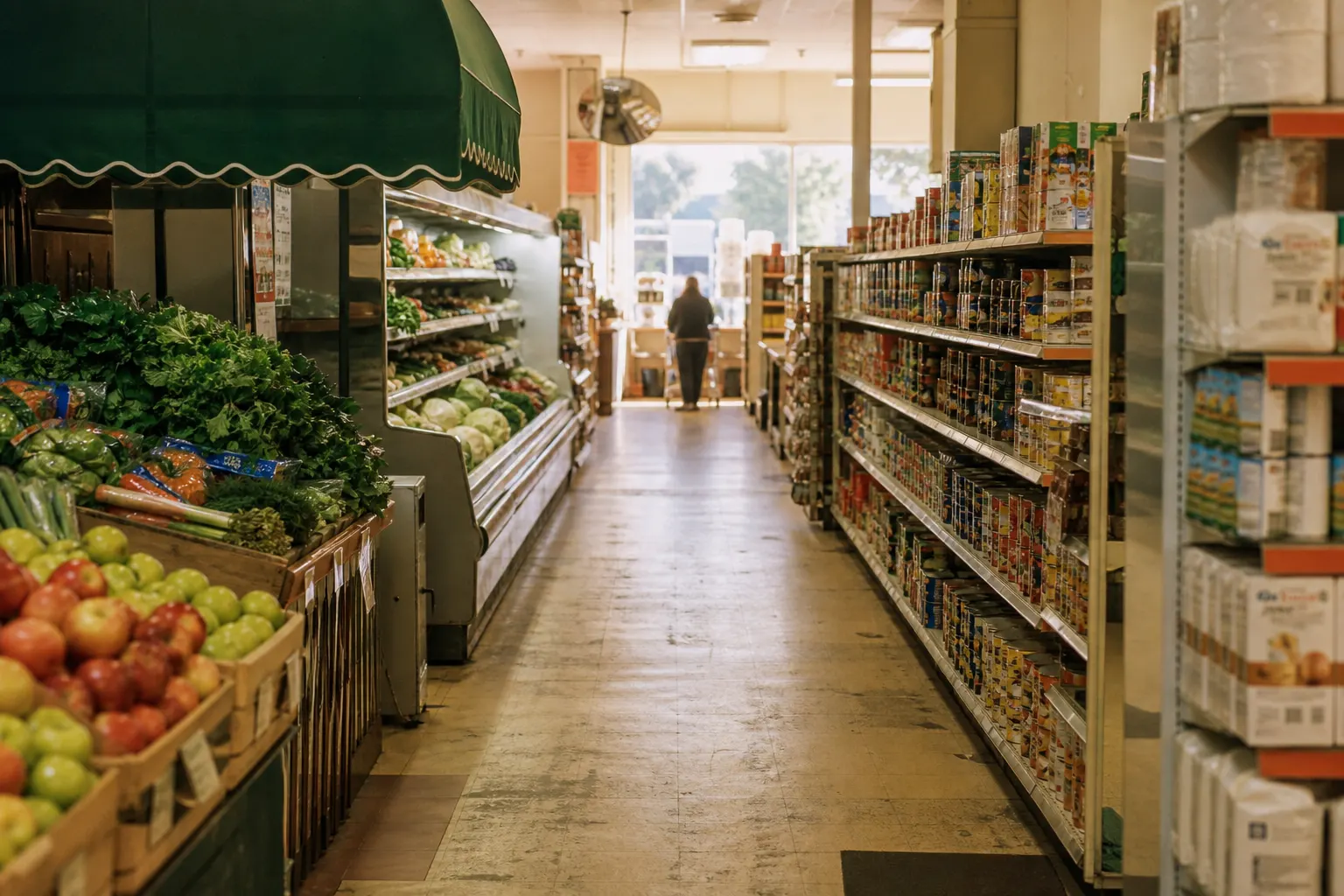
Generated illustration for this page. Not a listed store and not a photograph of a specific owner.
Sales per square foot — This grocery’s sales divided by selling area. Use weekly dollars over weekly feet or annual over annual; do not mix a year of sales with a week of area. FMI publishes weekly sales per square foot of selling area for supermarkets at $19.59 in 2025. That figure is channel context. It is not a grade for this box.
Grocery Store Business Broker — HedgeStone Business Advisors, led by Jason Taken — wants the selling-floor measurement and a year of scan data before anyone quotes psf in a CIM. Book a confidential intro with those two inputs. What is a good sales per square foot is the short question page. This page is the usage.
Selling feet, not the parking lot
Selling area is the aisle and the perimeter the shopper walks. It is not the back room, the compressor closet, the office, or the parking stalls. A 12,000-square-foot building with 8,000 of selling floor is an 8,000-foot grocery for this ratio. Using the building shell makes a tight independent look lazy and a warehouse look busy.
Say whether you mean weekly or annual. FMI’s supermarket sample is weekly. If you annualize, say you annualized. Basket size is a different ratio — dollars per ticket, not dollars per foot. Traffic times basket is how you sanity-check a psf that looks impossible.
Benchmark KPIs by format is where format differences belong. A neighborhood box, a limited-assortment room, and a conventional supermarket do not share a selling-floor story. Do not grade an ethnic market’s dense small floor against a suburban supermarket sample.
The FMI weekly figure is a sample
FMI’s Food Industry Facts also put 2025 supermarket sales at $1 trillion, a 2024 U.S. supermarket count at 45,575 stores across the formats FMI lists, and average weekly sales per supermarket at $668,377. Those are channel facts. They describe a supermarket sample, not the independent you are selling. Your weekly total will not match $668,377 unless you are that sample. Your weekly psf will not match $19.59 unless your selling floor and mix look like that sample.
Use the channel numbers as a conversation starter, then compute this store. Export the scan. Sum the weeks. Divide by measured selling square feet. If the CIM quotes $19.59 as “the store’s psf,” the CIM is quoting FMI, not the file. Verifying sales with scan data is how you stop that.
A quiet rural room can still be a living. A crowded urban aisle can still throw no cash after labor and rent. Psf does not recast SDE. How to value a grocery store and the valuation hub stay on earnings plus inventory at cost.
Density is a clue, not a price
High psf can mean a small floor that works, or a store that is under-spaced and about to lose a cooler. Low psf can mean a warehouse that will never fill, or a selling floor padded with unused endcaps. Walk the box. Ask why empty gondolas exist. Ask whether seasonal space is in the denominator year-round.
Do not invent a “good” independent psf band on this page. There is no sourced independent-only table in this pack for that. There is FMI’s supermarket weekly $19.59, and there is this store’s scan.
When you have selling-area feet and a year of weekly scan, Book a confidential intro. The hour is for whether density matches the story on the CIM — not for grading an 8,000-foot neighborhood grocer against a supermarket sample it is not in.
Worked math for Grocery sales per square foot
These figures are a teaching walk-through for Grocery sales per square foot, not a quote and not a sold comp. Order of operations: weekly sales, recast SDE, inventory at cost, then a multiple band.
Input or output
Illustrative figure
Weekly sales (illustrative)
$92,000
Annual sales
$4,784,000
Recast SDE
$148,304 (3.1% of sales)
Inventory at cost
$239,200 (~20 turns)
Occupancy check
$110,032 / year (2.3% of sales)
Low going-concern
$491,317 at 1.70x SDE + inventory
High going-concern
$639,621 at 2.70x SDE + inventory
Sketch DSCR on a note
1.35
Inventory is cash at close, not a multiple. Confusing the two is how sellers over-ask and buyers under-cash the wire.
Book the intro call with your side of the table ready: seller files or buyer capital. The calendar is the only next step.
Download the worksheets, then book the call
Print these, mark them up, and bring the marked copy to the intro. They are educational. They are not a valuation letter and not a listing.
All downloadable guides.
Confidential Seller Playbook3 pages. Recast checklist, teaser rules, license calendar, and what to bring to the first call.
Buyer Underwriting Workbook3 pages. Sales proof, shrink, rent, SNAP, DSCR, and cash-to-close math a lender will fund.
SDE Valuation Worksheet2 pages. Line-by-line add-backs, inventory at cost, and a multiple band you can defend.
Closing & License Checklist2 pages. Count night, SNAP re-application, alcohol, tax clearance, and the first 30 days.
Frequently asked questions about Grocery sales per square foot
Is FMI’s $19.59 weekly psf my store’s target?
No. It is weekly sales per square foot of selling area for supermarkets in FMI’s 2025 Speaks sample. Your independent may be smaller, denser, or quieter. Compute this box from scan and a measured selling floor.
Do I divide by the whole building or the selling floor?
Selling area. Stockroom, receiving, and office are not the aisle. Mixing them with the sales floor makes a busy box look weak and a warehouse look busy.
Can a high psf replace recast SDE?
No. Density is a productivity clue. Price still sits on recast earnings plus inventory at cost. A crowded aisle with no cash to the owner is not a better multiple.
What if I only have weekly sales and no floor plan?
Then you do not have psf. Measure selling feet or stop quoting the ratio. A weekly total without area is a rumor with a denominator missing.
Start a confidential grocery conversation
Whether you are exiting or acquiring, pick a time and we will talk through the file.
This page is educational information from Grocery Store Business Broker (HedgeStone Business Advisors). It is not legal, tax, or investment advice. Licensing, tax, and financing rules vary by state and deal. Confirm every item with counsel and your lender before you sign.
Ready when you are. Jason Taken will talk through the file.