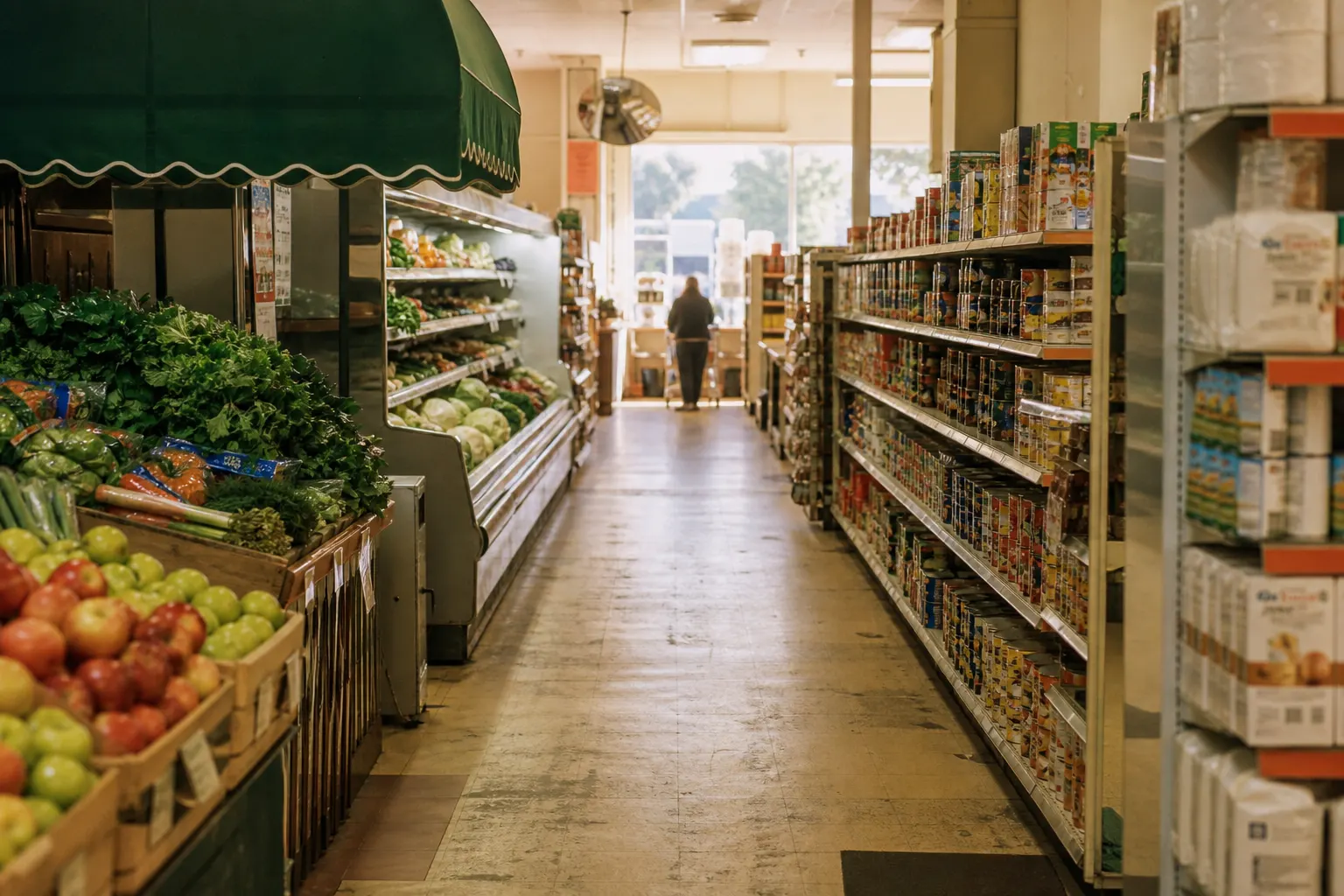
Generated illustration for this page. Not a listed store and not a photograph of a specific owner.
Control state — A jurisdiction where the state or a county is the wholesaler, and often the retailer, of distilled spirits, per the National Alcohol Beverage Control Association. NABCA lists seventeen control states; some additional local jurisdictions, including Montgomery County, Maryland, use the model.
Open the NABCA directory before you write “liquor license” on a grocery CIM. Grocery Store Business Broker — HedgeStone Business Advisors, led by Jason Taken — treats spirits, beer, and wine as separate files. Book a confidential intro with the alcohol list and the last agency correspondence. Email jason.taken@hedgestone.com if you want that hour. State-by-state alcohol regime is the longer map.
What NABCA control actually means
In a control jurisdiction the state (or a county) stands in the wholesale lane for distilled spirits and often operates the retail store that sells them. That is why “the grocery liquor license” is usually the wrong phrase in Pennsylvania or Utah: spirits sit in the state store system. The supermarket may still sell beer, or beer and wine, under a different class. License-state files — where private wholesalers and private retailers handle spirits — are a different map. Do not import a license-state story onto a control-state box.
NABCA’s directory is the sourced count: seventeen control states, plus additional local control jurisdictions in places such as Alaska, Maryland, Minnesota, and South Dakota. NABCA also describes “18 control jurisdictions” when counting Montgomery County, Maryland. Use the directory for the current list. Do not invent a eighteenth state from memory.
Beer, wine, and spirits are separate files
Price what the grocery actually sells. A beer-only set, a beer-and-wine set, and a full spirits set are three different cash-flow and diligence stories. Liquor license is the grocery term for the permit you actually hold. A quota license is a scarcity rule in some license states; it is not a synonym for control. What happens if the liquor license is quota? belongs on quota files. Control files need the agency that runs the state store and the class that covers beer or wine.
Name beer, wine, and spirits as separate lines. Say who wholesales spirits. Say whether a state store sits in the same center or across the lot — that is competition and convenience, not a transferable asset. Do not write that a grocery spirits license conveys if the state retails the bottles. Do not bury a beer-and-wine transfer inside “licenses to be assigned.”
Inventory night follows the same split. Spirits on a grocery floor in a license state are countable product. Spirits that never sit in the grocery because the state retails them are not in the room. Count what is on the shelf you are buying.
If you have the alcohol list and the state’s current classes, book the control-state conversation. Bring permits, the last correspondence, and a note on whether a state store shares the parking lot. The hour is for beer, wine, and spirits as three files.
An illustrative recast on Grocery alcohol in a control state
Use this napkin recast on Grocery alcohol in a control state when you book the call. It is labeled illustrative. BizBuySell's 2025 grocery sold-business earnings multiple averaged 3.38, with a 2021-2025 IQR of 1.60-3.15.
Input or output
Illustrative figure
Weekly sales (illustrative)
$168,000
Annual sales
$8,736,000
Recast SDE
$410,592 (4.7% of sales)
Inventory at cost
$436,800 (~20 turns)
Occupancy check
$305,760 / year (3.5% of sales)
Low going-concern
$1,257,984 at 2.00x SDE + inventory
High going-concern
$1,545,398 at 2.70x SDE + inventory
Sketch DSCR on a note
1.51
If weekly sales or shrink move 8 percent, the SDE and the note move with them. That is why Jason Taken starts with scan data and the lease, not with a neighbor's rumor multiple.
Book the intro call with your side of the table ready: seller files or buyer capital. The calendar is the only next step.
Download the worksheets, then book the call
Print these, mark them up, and bring the marked copy to the intro. They are educational. They are not a valuation letter and not a listing.
All downloadable guides.
Confidential Seller Playbook3 pages. Recast checklist, teaser rules, license calendar, and what to bring to the first call.
Buyer Underwriting Workbook3 pages. Sales proof, shrink, rent, SNAP, DSCR, and cash-to-close math a lender will fund.
SDE Valuation Worksheet2 pages. Line-by-line add-backs, inventory at cost, and a multiple band you can defend.
Closing & License Checklist2 pages. Count night, SNAP re-application, alcohol, tax clearance, and the first 30 days.
Frequently asked questions about Grocery alcohol in a control state
What does NABCA mean by a control state?
A jurisdiction where the state or a county is the wholesaler of distilled spirits and often the retailer as well. NABCA lists seventeen control states, plus additional local control jurisdictions. The directory is the source, not a rumor about “dry states.”
Can a grocery in a control state still sell beer or wine?
Often yes, under a separate class or permit. Spirits may remain in the state store. Do not collapse beer, wine, and spirits into one asset called “the liquor license.” Read the state’s current classes.
How should a CIM describe alcohol in a control state?
Name beer, wine, and spirits as separate files. Say who wholesales spirits. Say whether a state store sits in the same center. Do not write that a grocery spirits license conveys if the state retails the bottles.
Does a control-state grocery still need alcohol diligence?
Yes. Beer and wine transfers, quota rules where they exist, and any agency consent still have clocks. Control changes who holds spirits. It does not cancel the rest of the alcohol calendar.
Start a confidential grocery conversation
Whether you are exiting or acquiring, pick a time and we will talk through the file.
This page is educational information from Grocery Store Business Broker (HedgeStone Business Advisors). It is not legal, tax, or investment advice. Licensing, tax, and financing rules vary by state and deal. Confirm every item with counsel and your lender before you sign.
Ready when you are. Jason Taken will talk through the file.