Can I put FMI weekly sales on my CIM as this store’s number?
No. $668,377 average weekly sales per supermarket in 2025 and $19.59 weekly sales per square foot are FMI channel samples. Quote last week’s scan, not the Speaks average.
Grocery Store Business Broker · HedgeStone Business Advisors · Jason Taken
Last updated 2026-09-04
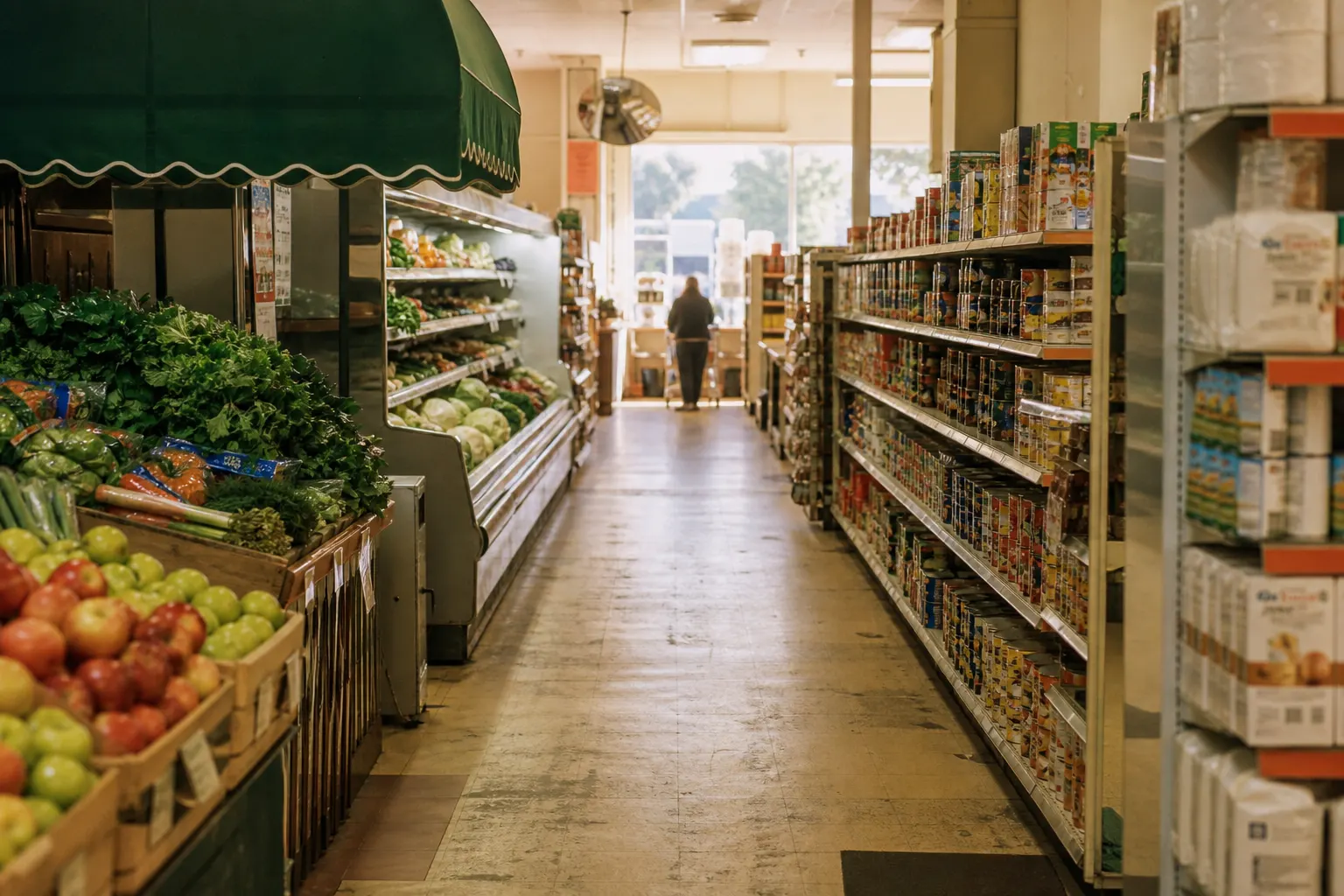
Mark last week’s scan before you argue the industry. FMI published $1 trillion in 2025 supermarket sales and counted 45,575 U.S. supermarkets in 2024. Those numbers describe a channel that includes conventional boxes, limited-assortment stores, supercenters, warehouse and club formats, natural and gourmet, and military commissaries. Grocery Store Business Broker — the grocery practice of HedgeStone Business Advisors, led by Jason Taken — uses that channel as weather. The store you want to sell or buy is a payroll, a lease, and a warehouse book.
Census NAICS 445110 is the official box for supermarkets and other grocery retailers except convenience. The monthly pulse in this pack is Census retail sales for NAICS 44511: $72,706 million in June 2026, not seasonally adjusted, via FRED. That is a national register tape. It does not tell you whether your meat case holds Saturday or whether the landlord will assign. Start at the valuation hub if you came here looking for a price. This essay is how to read the industry without letting it write your CIM.
FMI’s $668,377 average weekly sales per supermarket in 2025 and $19.59 weekly sales per square foot of selling area are the same kind of number: useful for orientation, dangerous as a sentence about this box. An 8,000-square-foot neighborhood store that scans $95,000 in a normal week is not failing the industry. It is a different format. A 28,000-square-foot independent that cannot print $400,000 in a week is not “below FMI.” It is a store with a mix, a trade area, and a labor graph you still have to recast.
Put the channel facts in a footnote if a buyer asks for context. Put last year’s 52-week scan, department mix, and EBT settlements in the body. Read sales per square foot and scan data. The KPI-by-format guide is where those channel rulers get matched to neighborhood, rural, natural, and specialty boxes. Do not borrow a supermarket weekly figure for a rural grocery or a gas-and-grocery site.
A teaching week: $142,000 scanned, no holiday, no snow-out. Times 52 is $7,384,000. That is a conversation starter, not a valuation. If recast SDE after market rent is 3.1 percent, SDE is about $228,900. Add sellable inventory at cost as a second check. Then ask whether a financed buyer can carry both. The valuation calculator lets you change the inputs. The hour on the intro is for whether those inputs are real.
Grocery is high-turn and low-net. FMI’s 2.1 percent average net profit for food retailers in 2025 is a Speaks sample. Independent operators often talk in a 1–3 percent band. This pack does not treat that band as an official NGA census. Treat it as conversation. Recast the file. Net margin after owner add-backs is not the same as the tax-return bottom line, and it is not the same as gross margin by department.
Meat and produce can sink a “healthy” storewide blend. Center store and the perimeter do not share a clock. Shrink that repeats every year is the business. Stop calling it a one-time add-back. Inventory turns on grocery dry are not turns on wine or supplements. Read shrink, margin, and turns and recasting a grocery P&L before you decide the industry is “good enough” to skip the recast.
Related-party rent that juiced last year’s earnings will reverse on day one. CAM true-ups can erase a year of “extra” SDE. Labor moves with the state minimum-wage table, not with a national slogan. Use the rent-as-percent-of-sales checker as a sanity check. Do not invent a national rent law. Occupancy as a percent of sales is usually the first underwriting question on a neighborhood grocery.
Working capital is the cash to buy the next load. It is not a vibe. A channel that looks busy in FMI’s weekly-sales print can still starve an independent that is over-advanced at the warehouse. Wholesaler over-advances are debt. They are not an add-back. See wholesaler agreements at sale.
USDA FNS: SNAP authorization does not transfer. The new owner files a new application. A trillion-dollar supermarket year does not move that rule. Budget downtime in cash and in the story you tell the landlord. EBT deposits should reconcile to the SNAP story. A gap is mix, downtime, or fiction. Read what happens to SNAP when you sell and EBT diligence.
Alcohol is a class, a quota, or a control-state product. NABCA lists 17 control states. The industry outlook does not turn “the liquor license” into one magical asset. Read state alcohol regimes and transferring a liquor license. WIC, lottery, and tobacco sit with their own agencies. Lottery contracts are often personal. Confirm before you count commission as durable.
A lease with 24 months or less and no options is a price cut, not a footnote. Assignment, exclusive use, and co-tenancy still surprise civilians in a “strong” year. Read lease diligence. Unreported cash does not survive SBA and does not survive a serious conventional buyer, even if Census grocery sales look firm. See selling with unreported cash.
Most independents still close as asset sales. You are selling the going concern, the equipment, and the stockroom. You are not selling a promise that EBT works on Tuesday morning. Read asset sale versus stock sale. Tax clearance belongs in escrow language. Bulk-sale or successor-liability practice can still exist after UCC Article 6 died. See state bulk-sales notes.
Independents do not get paid on FMI’s trillion. They get paid on recast SDE times a grocery earnings multiple, plus inventory at cost, minus the clocks that scare a lender. BizBuySell grocery and supermarket sold businesses: 3.38 average earnings multiple in 2025; 2.66 five-year average; IQR 1.60–3.15 for 2021–2025. The 2025 sold sample also printed a 0.43 average revenue multiple. That last number is a sanity check. Revenue multiples hide rent and labor. Return to SDE.
Those BizBuySell figures are a national listing-site sold sample. They are not a chain M&A print and they are not an independent-only table. Banner transferability and remaining lease term move the check more than a sentence about “the industry.” Read the multiples report and how to value a grocery store. Compare offers on cash at close, note terms, inventory treatment, and license risk — comparing offers.
If you own the dirt, recast the store on market rent, then price the building as a second asset. A rural box can be a good living and a difficult loan in the same year the supermarket channel prints a record. Those are different questions. See selling with a lease versus real estate.
SBA 7(a) can finance a change of ownership. The published maximum is $5 million. Eligibility still requires a for-profit U.S. business that is small under SBA rules, creditworthy, and unable to obtain the desired credit on reasonable terms elsewhere. Grocery experience still matters. A “good industry” slide does not replace a recast a lender will believe. Read SBA 7(a) for grocery. Seller notes often sit on standby behind SBA. Read the standby, not the folklore.
DSCR is annual cash flow over annual debt service. Hope is not a ratio. Use the cash-to-close estimator so the first warehouse drop after funding is in the stack, not in a speech.
A healthy channel does not mean every trade area is easy. Dollar stores, clubs, and limited-assortment banners take center-store trips. Independents keep the trips they earn on the perimeter: meat, produce, deli, and language on the floor. Ethnic mix without language on the floor is a shrink plan. Read trade-area math before you treat FMI’s supermarket count as a demand study for your ring.
Format pages exist because the outlook is not one store. A full-line independent supermarket is a payroll-and-wholesaler file. A natural or organic store should not be judged against supermarket weekly sales per foot. A specialty market may be a wine-and-labor business with grocery as a supporting aisle. A food co-op is a governance file before it is an SDE file. A discount or salvage box is a trading business. Do not force one outlook paragraph onto all of them.
HFFI and state healthy-food programs change. Do not quote a stale dollar cap. Food-desert rhetoric does not replace a P&L. If you are buying in a thin-access area, read buying in a food desert and still recast the week.
The M&A landscape essay is the companion: independents trade on SDE; chain deals are a different sport. Do not mix the multiples because a newspaper said grocery is consolidating.
A CIM that opens with FMI’s trillion is a brochure. Open with last year’s 52-week scan, department mix, recast SDE, remaining lease term, and the license list. Put channel facts in a short footnote if a first-time buyer asks “is grocery healthy.” Then walk them back to the week. Read how to read a CIM so you know which page a serious operator marks first.
Sales-tax filings are a corroboration tool where food is taxed or partially taxed. They will not match a Speaks average. They should match your scan closely enough that a CPA can explain the gap. See state grocery sales tax. Preparing three years of financials is the boring work that makes an outlook useful.
Inventory night still needs rules in a “good” year: what is unsellable, who pays the crew, how disputes resolve. FIFO versus a messy room is how you start a fight at 2 a.m. Read how inventory is counted. Transition hours are a close condition. Write them. See transition and training. The first 90 days after close are vendor trust, shrink, and not changing the mix for sport — post-closing 90-day plan.
Do not wait for a better industry print. Wait for a file you can prove. A quiet supermarket month on Census does not make your meat case unsellable. A loud supermarket year does not make your short lease a trophy.
Print the SDE worksheet. Write five lines in the margin. Last week’s sales times 52. A recast margin you can defend with add-backs, not a slogan. Annual COGS divided by a turn count that matches how this format actually stocks. Inventory at cost. A multiple inside the BizBuySell grocery IQR unless the lease or licenses force you lower. If you cannot fill those five lines, the call is still worth having. That is what the hour is for.
Say in one sentence what you want after close. Cash. A note. The building. A job. Then say what you do not have: tax returns, scan data, a written lease, or a SNAP history. Missing paper is common. Hiding it is how the hour dies. The seller hub and buyer hub hold the sequence. How it works and the FAQ cover NDA to count night.
Counsel who have never closed grocery will rediscover SNAP in week six. Send them working with attorneys and CPAs before they draft in a vacuum. Inventory night needs rules: what is unsellable, who pays the crew, how disputes resolve. Read how inventory is counted. The LOI should say how inventory is counted and how licenses are conditioned.
Jason Taken will recast the outlook in that order: weekly sales you can prove, SDE a lender will believe, inventory at cost, then license clocks. Bring the marked worksheet. Bring last week’s scan if that is all you have.
Book a confidential intro. The channel is context. Your file is the work.
These figures are a teaching walk-through for Grocery Industry Outlook, not a quote and not a sold comp. Order of operations: weekly sales, recast SDE, inventory at cost, then a multiple band.
| Input or output | Illustrative figure |
|---|---|
| Weekly sales (illustrative) | $228,000 |
| Annual sales | $11,856,000 |
| Recast SDE | $367,536 (3.1% of sales) |
| Inventory at cost | $846,857 (~14 turns) |
| Occupancy check | $343,824 / year (2.9% of sales) |
| Low going-concern | $1,637,059 at 2.15x SDE + inventory |
| High going-concern | $1,894,335 at 2.85x SDE + inventory |
| Sketch DSCR on a note | 1.49 |
Inventory is cash at close, not a multiple. Confusing the two is how sellers over-ask and buyers under-cash the wire.
Book the intro call with your side of the table ready: seller files or buyer capital. The calendar is the only next step.
Print these, mark them up, and bring the marked copy to the intro. They are educational. They are not a valuation letter and not a listing. All downloadable guides.
Have the file ready so the hour is a recast, not a scavenger hunt. Then pick a time.
Get a specialist on the other side of the table
Grocery deals turn on licenses, inventory, and a recast a lender will believe. Book the intro and bring the file.
Book an Intro Call With Jason TakenNo. $668,377 average weekly sales per supermarket in 2025 and $19.59 weekly sales per square foot are FMI channel samples. Quote last week’s scan, not the Speaks average.
No. Independents trade on recast SDE plus inventory at cost. BizBuySell’s 2025 grocery/supermarket sold sample averaged 3.38× earnings; the 2021–2025 IQR is 1.60–3.15. Lease term and license clocks move the check more than a channel headline.
FMI’s 2.1% average net profit for food retailers in 2025 is a Speaks sample. Trade talk often cites a 1–3% independent range; this pack does not treat that range as an official NGA table. Recast your P&L.
No. USDA FNS: SNAP authorization does not transfer. The new owner files a new application regardless of channel sales.
Bring last week’s scan, a marked SDE worksheet, and the lease abstract. Book a confidential intro and we recast the file against channel context, not as a quote.
Start a confidential grocery conversation
Whether you are exiting or acquiring, pick a time and we will talk through the file.
Book an Intro Call With Jason TakenThis page is educational information from Grocery Store Business Broker (HedgeStone Business Advisors). It is not legal, tax, or investment advice. Licensing, tax, and financing rules vary by state and deal. Confirm every item with counsel and your lender before you sign.
Ready when you are. Jason Taken will talk through the file.
Book a confidential intro