Which grocery wholesaler is best?
The one that already drops this store on terms the buyer can assume. This pack does not rank houses or invent market share. Confirm the book on the statements.
Grocery Store Business Broker · HedgeStone Business Advisors · Jason Taken
Last updated 2026-09-04
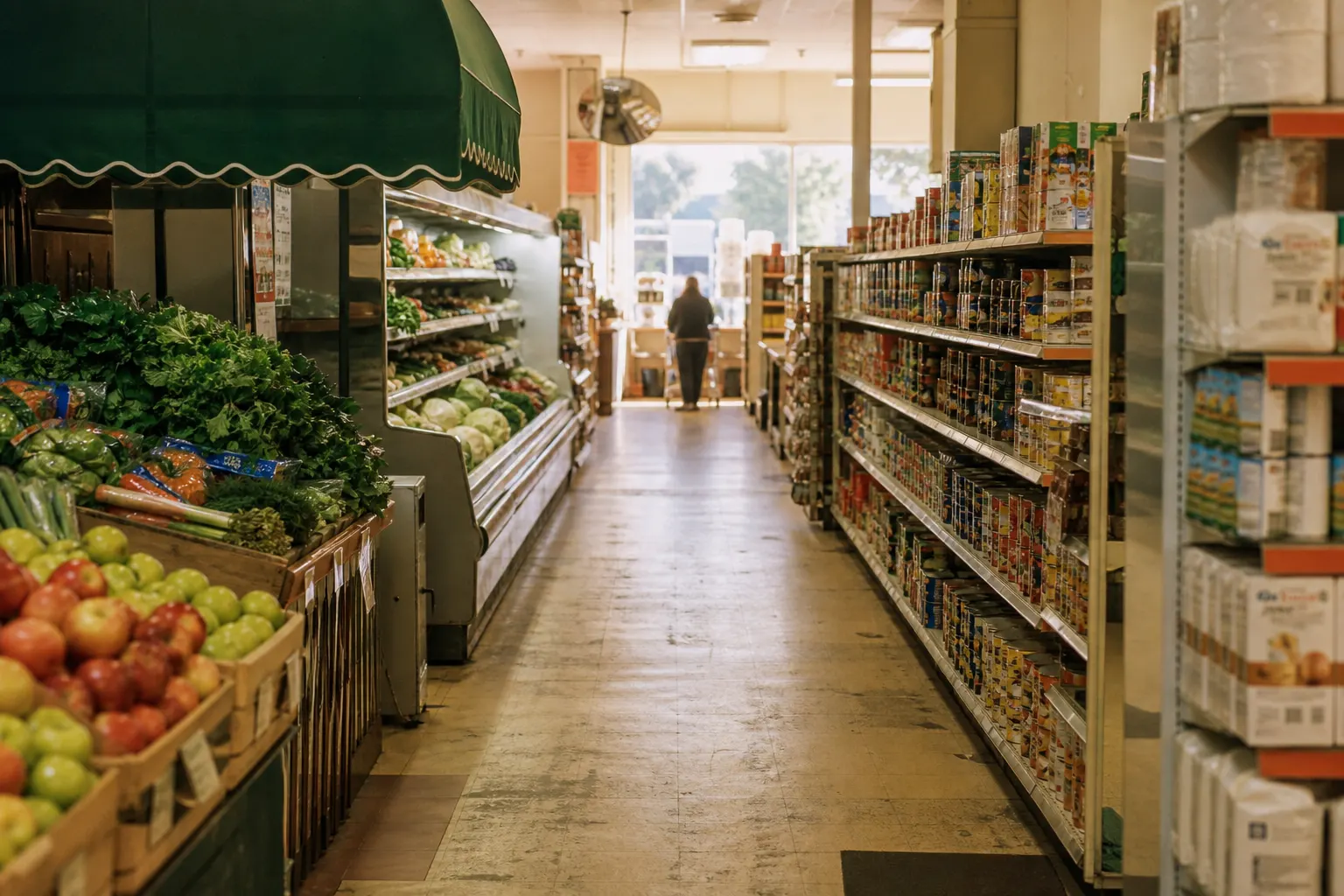
Confirm the actual book on the store. AWG, C&S, UNFI, Wakefern, SpartanNash, and regional co-ops are names you will hear in almost every independent file. They are not interchangeable, and a directory is not diligence. Grocery Store Business Broker — the grocery practice of HedgeStone Business Advisors, led by Jason Taken — starts with twelve months of invoices and the supply agreement, then decides whether a buyer can stay on that book or must convert.
FMI’s $1 trillion in 2025 supermarket sales and $668,377 average weekly sales per supermarket describe the channel those warehouses serve. They do not tell you whether this drop still clears the minimum. $19.59 weekly sales per square foot is the same kind of channel ruler. Use it on the industry outlook. Price the warehouse relationship on paper. The companion essay is wholesaler agreements at sale. This page is who the houses are, and how not to confuse them.
A wholesaler is the primary grocery supplier. The supply agreement, personal guarantees, rebate calendar, and any inventory over-advance are often more important to closing than the liquor license. Ask whether the book, the rebate calendar, and any inventory financing transfer. They often do not, automatically.
A retailer-owned wholesale cooperative is a house the stores own together. Associated Wholesale Grocers (AWG) is the name independents use most often in that sentence. Wakefern is the ShopRite retailers’ cooperative. Associated Food Stores and other regional co-ops do the same job in their territories: warehouse, private label, sometimes a banner. Equity, patronage, and a membership agreement sit in the file. Selling the store may require the co-op’s consent or a repurchase of member equity. That is not a consumer vote at the vestibule.
A consumer food co-op is the other meaning of “co-op.” Members own the store. Patronage rebates, a board, and bylaws make recast SDE a different exercise. Selling “the co-op” may be a member vote, not an asset sale to a private buyer. Supply may run through UNFI and, if affiliated, National Co+op Grocers — confirm membership in the file before you name NCG. Do not force a BizBuySell multiple onto a cooperative without governance review. Do not call an AWG supermarket a food co-op in the CIM.
Public or privately held wholesalers sit in a third pile. C&S Wholesale Grocers and UNFI are the names buyers use when the store is a house account rather than a member. SpartanNash supplies independents and also operates corporate stores. The diligence question is the same: what does the agreement say happens on a change of control, and what does the buyer have to sign.
This pack does not invent warehouse market share, member counts, or a ranking. If your house is not named here, pull the statements anyway. The legal name on the invoice is the directory that matters.
AWG is the independent-owned cooperative many full-line stores already know. The file usually includes a membership interest, a supply commitment, and sometimes a banner program. Over-advances and personal guarantees are common enough that you should look for them on purpose. A buyer who cannot join, or who will not guarantee, needs a convert plan. See independent supermarket.
C&S is a wholesaler independents use as a primary book or a secondary. Corporate customers and independent customers can sit in the same warehouse network. Your store’s program, drop size, and credit terms are on your agreement. Do not borrow another operator’s story.
UNFI shows up on conventional independents and, heavily, on natural and organic stores. KeHE is the other specialty name in that channel. Supplement dating and perishable shrink can erase recast SDE even when the warehouse brand looks “premium.” FMI supermarket averages are the wrong benchmark for that format.
Wakefern is not a logo you peel off for a first-time buyer. It is a retailer-owned cooperative tied to ShopRite identity and warehouse equity. Treat a Wakefern store as a membership-and-governance file first. If the box in front of you is not Wakefern but buys a lookalike private label, say that clearly. Confusion here wastes diligence weeks.
SpartanNash and regional houses — Associated Food Stores and other territory co-ops — are often the only drop that will stop in a rural town. Freight and minimums are the story. A warehouse about to raise the drop minimum is a red flag this pack names without inventing a dollar. Confirm it.
Ethnic independents may use a conventional house for center store and a web of importers for the identity SKUs. An Asian grocery, Hispanic grocery, or Indian grocery can live or die on importer credit the primary wholesaler never sees. List those vendors. A buyer who only reads the AWG statement will miss the store.
Specialty shops may live on KeHE, UNFI specialty, and local artisans with almost no conventional grocery wholesale. Discount or salvage boxes buy lots, not a weekly book. Gas-and-grocery sites often have almost no grocery wholesale at all. Do not paste this directory onto those formats.
The weekly drop is the heartbeat. If the house requires a minimum the store barely clears, a sales dip or a convert becomes existential. Rural files fail here more than they fail on a multiple. Neighborhood boxes that buy cash-and-carry or a secondary wholesaler have a different problem: thin private-label and DSD that will not service a small drop. See neighborhood grocery.
Rebates and patronage are real money when they repeat. They are not a second store. Diligence the calendar. A one-time warehouse credit is not run-rate SDE. Recurring advertising bills tied to the house belong in the recast if the buyer keeps the book. Read recasting a grocery P&L.
Over-advances are inventory financing. They are debt. They are not an add-back. Someone pays the house at close, or the buyer signs a guarantee a lender will not like. SBA 7(a) can finance a change of ownership; the published maximum is $5 million. A warehouse debt the buyer cannot assume still kills the stack. Read SBA 7(a) for grocery and working capital. Use the cash-to-close estimator so the first drop after funding is in the number.
Personal guarantees sit next to the over-advance. A seller who stays on a guarantee after close is still in the deal. Write a release. If the house will not release, you do not have a clean asset sale.
BizBuySell grocery/supermarket sold businesses averaged 3.38× earnings in 2025, with a 2021–2025 IQR of 1.60–3.15. A warehouse the buyer cannot keep moves you toward the low end faster than a debate about the average. This pack does not invent a “good wholesaler” premium.
DSD vendors stock the store themselves: bread, soda, chips, ice cream, some dairy. Those sales and that labor do not always sit cleanly on the wholesaler invoice. A buyer who only reads the warehouse statement will miss a large piece of the beverage aisle. List the DSD routes. Ask which ones will drop a new owner without a new credit application. They keep delivering after a sloppy close only if someone is paying them.
Center store is wholesaler-book territory and the part of the mix most exposed to dollar-store and e-commerce leakage. The perimeter is why customers pass those competitors. Meat, produce, and deli often ride a mix of warehouse, local packers, and DSD. Department gross margin hides in a storewide blend. Read shrink, margin, and turns.
Scan data plus warehouse and DSD invoices is the adult conversation. A weekly-sales spreadsheet without department mix is a rumor. See verifying sales with scan data. FMI’s 2.1 percent average net profit for food retailers in 2025 is a Speaks sample. It does not replace those invoices.
USDA FNS: SNAP authorization does not transfer. The warehouse will not carry EBT for the new owner. Budget downtime. Read SNAP when you sell. Alcohol is still a state privilege. The house that sells center store is not the ABC.
Write the legal name on the latest invoice, the buyer number, the drop day, and whether the store is a member or a house account. Attach the supply agreement, any membership certificate, the rebate calendar, and the over-advance statement. Circle assignment and change-of-control language. Then decide keep-the-book or convert. Buying and converting is the convert essay. The banner directory is the fascia essay. Do not do those jobs in the wrong order.
Sequence the warehouse conversation after an NDA and a serious buyer. Telling the house first is how the floor hears you are exiting. Read how to sell confidentially. Counsel who have never closed grocery will treat the warehouse as a vendor like the copier company. Send them working with attorneys and CPAs and this page.
Inventory night still counts sellable stock at cost. Product the incoming book will not take is a dispute waiting for 2 a.m. Write the rule in the LOI. See how inventory is counted.
Secondary wholesalers and cash-and-carry houses sit under the primary book more often than CIMs admit. A neighborhood store may buy grocery dry from a cash-and-carry, beverages DSD, and produce from a local jobber. That is three credit files, not one directory line. List them. Ask which will open for a new owner without the seller’s guarantee. A convert that only names AWG or UNFI and ignores the produce house is not a convert. It is a dark wet rack.
Credit applications take time. The house will want tax returns, a personal financial statement, and sometimes grocery experience. SBA 7(a) does not replace that packet. Sequence it after NDA so the floor does not hear you are shopping warehouses. If two houses will quote the same box, recast both drop minimums and both private-label sets before you pick. Do not assume the cheaper case cost wins. Freight, shorts, and rebate lag change the week.
Equipment financing through the warehouse — racks, cases, a front end — is another debt schedule. It is not an add-back. Attach it next to the over-advance. A buyer who “assumes the store” and misses a warehouse equipment note will meet that collector after Monday.
A teaching stack — not a quote. Recast SDE $260,000. Inventory at cost $200,000. Over-advance $85,000 still on the seller. The going-concern conversation cannot ignore that $85,000. The national multiple sample does not pay it for you.
Print the SDE worksheet. Mark warehouse charges, patronage, and the guarantee. Bring last week’s scan and the latest drop invoice. Say in one sentence whether the buyer must keep this house. Then say what you do not have: the agreement, the equity statement, or a clear over-advance balance.
Jason Taken will recast the directory in that order: which house actually drops you, whether the buyer can stay, what debt sits on the book, then SDE and inventory. The valuation hub is the pricing spine. The seller hub and buyer hub hold the sequence.
Book a confidential intro. Bring the invoice if that is all you have. The hour is for the book on this store, not for a national roster.
Use this napkin recast on Grocery Wholesaler Directory when you book the call. It is labeled illustrative. BizBuySell's 2025 grocery sold-business earnings multiple averaged 3.38, with a 2021-2025 IQR of 1.60-3.15.
| Input or output | Illustrative figure |
|---|---|
| Weekly sales (illustrative) | $124,000 |
| Annual sales | $6,448,000 |
| Recast SDE | $303,056 (4.7% of sales) |
| Inventory at cost | $322,400 (~20 turns) |
| Occupancy check | $212,784 / year (3.3% of sales) |
| Low going-concern | $973,970 at 2.15x SDE + inventory |
| High going-concern | $1,277,026 at 3.15x SDE + inventory |
| Sketch DSCR on a note | 1.47 |
If weekly sales or shrink move 8 percent, the SDE and the note move with them. That is why Jason Taken starts with scan data and the lease, not with a neighbor's rumor multiple.
Book the intro call with your side of the table ready: seller files or buyer capital. The calendar is the only next step.
Print these, mark them up, and bring the marked copy to the intro. They are educational. They are not a valuation letter and not a listing. All downloadable guides.
Have the file ready so the hour is a recast, not a scavenger hunt. Then pick a time.
Get a specialist on the other side of the table
Grocery deals turn on licenses, inventory, and a recast a lender will believe. Book the intro and bring the file.
Book an Intro Call With Jason TakenThe one that already drops this store on terms the buyer can assume. This pack does not rank houses or invent market share. Confirm the book on the statements.
No. Wakefern is a retailer-owned wholesale cooperative. A consumer food co-op is member-owned at the store. Do not confuse them in a CIM or LOI.
Often yes in the first weeks, and sometimes yes as a condition of the banner. A convert is a second deal: new application, new minimums, new private label. Recast it.
Inventory financing from the house. It is debt. It is not an add-back. Someone pays it at close or the buyer inherits a guarantee they cannot carry.
Only if another house will take the drop size. Fragile minimums are the rural story. Confirm before you price a convert.
No. Names here are orientation. Invoices, rebate calendars, and the supply agreement are the file.
Start a confidential grocery conversation
Whether you are exiting or acquiring, pick a time and we will talk through the file.
Book an Intro Call With Jason TakenThis page is educational information from Grocery Store Business Broker (HedgeStone Business Advisors). It is not legal, tax, or investment advice. Licensing, tax, and financing rules vary by state and deal. Confirm every item with counsel and your lender before you sign.
Ready when you are. Jason Taken will talk through the file.
Book a confidential intro