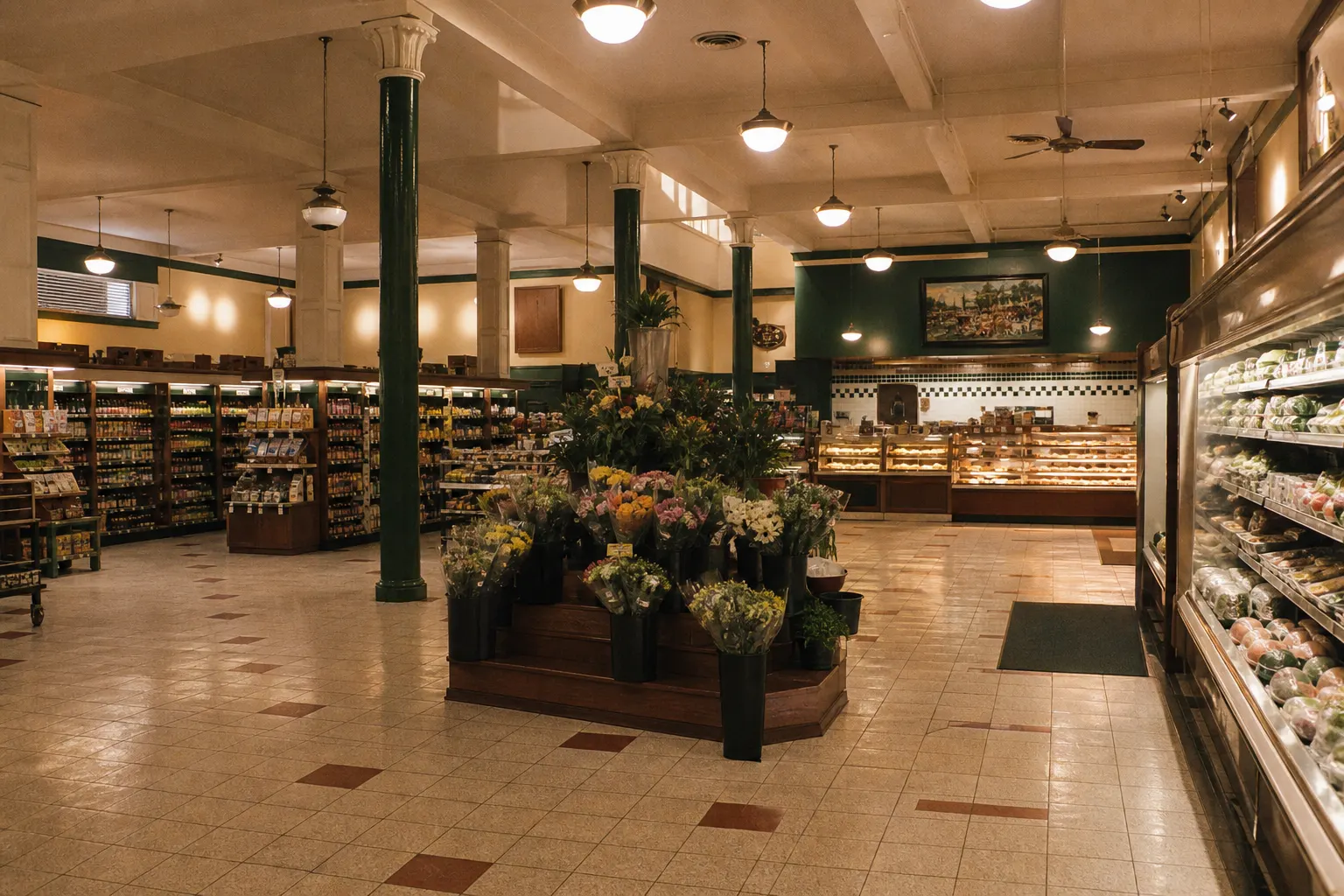
An independent supermarket sells as a labor graph, a wholesaler book, and a lease with years left on it. It does not sell as a percent of last year’s sales. Grocery Store Business Broker — the grocery practice of HedgeStone Business Advisors, led by Jason Taken — packages that file so an operator can fund it. Confidential outreach is the default. Read the seller hub for the whole sequence. This page is the full-line independent.
FMI published $1 trillion in 2025 supermarket sales and counted 45,575 U.S. supermarkets in 2024. Those numbers describe the channel. Your box is a payroll store with thin net after recast. FMI’s $668,377 average weekly sales per supermarket in 2025 and $19.59 weekly sales per square foot are channel samples. Do not paste them onto a 22,000-foot independent unless last week’s scan data says you actually do that volume.
The independent is a payroll-and-wholesaler store
Full-line economics mean high weekly volume, heavy payroll, and heavy occupancy. Net after recast is thin. FMI’s 2.1 percent average net profit for food retailers in 2025 is a food-retailer sample. It is not your add-back list. Independents live or die on wholesaler terms, shrink, and labor. A chain circular does not save a store that cannot staff the meat case on Saturday.
Department mix is the adult conversation. Storewide gross margin can look healthy while meat and produce sink the week. Center store and the perimeter do not share a clock. Inventory turns on grocery dry are not turns on service meat. A buyer who only sees a weekly-sales spreadsheet is reading a rumor. Print the SDE worksheet and mark owner pay, one-time repairs, and related-party rent before you argue a multiple.
Suppose a normal week scans $188,000. Annualized sales are $9,776,000. If recast SDE is 3.3 percent after you put rent back to market, SDE is $322,608. That is a teaching example, not a quote. Divide annual COGS by the turns that match how you actually stock. Add sellable inventory at cost as a separate line. Then decide whether a financed buyer can carry both the going-concern check and the count.
Related-party rent that juiced earnings will reverse on day one. Pull it out of SDE before you fall in love with the high end. Recurring shrink is the business. Stop calling it a one-time item. Read recasting a grocery P&L and preparing three years of financials.
Pricing against the grocery sold sample, not a chain deal
BizBuySell grocery and supermarket sold businesses: 3.38 average earnings multiple in 2025; 2.66 five-year average; IQR 1.60–3.15 for 2021–2025. A 0.43 average revenue multiple on the 2025 sold sample is a sanity check. It is not a pricing tool. Those figures are a national listing-site sample. They are not an independent-supermarket-only multiple, and they are not a chain M&A print.
Banner transferability and remaining lease term move the check more than a slogan about “supermarket averages.” A banner the buyer cannot keep is a rebrand cost and a wholesaler conversation. A lease with 24 months or less and no options is a price cut. Read the valuation hub and how to value a grocery store. The multiples report is the same national sample in longer form.
Revenue multiples hide rent and labor. Use them to see whether a headline is silly, then return to SDE. Compare offers on cash at close, note terms, inventory treatment, and license risk. See comparing offers. Earn-outs are hard because the buyer controls mix after Monday. Holdbacks exist because grocery has shrink and successor tax risk. Write both into the LOI.
If you own the dirt, recast the store on market rent, then price the building as a second asset. Read selling with a lease versus real estate and grocery with real estate. A sale-leaseback can unlock owned real estate without pretending the store and the land are one number.
AWG, C&S, and the banner you may not keep
Most independents buy through AWG, C&S, UNFI, SpartanNash, or a regional co-op. That wholesaler relationship is the deal. Over-advances are debt. Personal guarantees the buyer cannot assume are a close killer. Banner program fees belong in the recast as continuing costs if the buyer will keep the fascia. Read wholesaler and banner agreements before you tell the warehouse you are selling.
DSD beverages, bread, snacks, and ice cream keep the perimeter alive. Those vendors keep delivering after a sloppy close only if someone is paying them. Sequence the warehouse conversation after an NDA and a serious buyer. Telling the wholesaler first is how the floor hears you are exiting.
Optional banners — IGA, Piggly Wiggly, and similar programs — are not free goodwill. They are contracts with fees, signage rules, and sometimes a right to object. Compare banner versus independent so you know what the buyer is actually purchasing. The wholesaler directory and banner directory are orientation, not a substitute for your statements.
Working capital is the cash to buy the next load. It is not a vibe. The buyer who can close has a plan for the first warehouse drop after funding. See working capital and the cash-to-close estimator.
Multi-store operators and first-time SBA buyers
The buyer pool for a full-line independent is specific. Multi-store independents adding a box. Owner-operators exiting a smaller neighborhood grocery. SBA 7(a) first-time buyers who already have grocery experience. That last group needs a file a lender will fund. The SBA 7(a) maximum is $5 million. A supermarket-sized independent plus inventory can press that ceiling. Read SBA 7(a) for grocery.
Unreported cash will not survive SBA or a serious conventional buyer. It is a disqualifier, not a feature. Read selling with unreported cash. First-time buyers should also read buying as a first-time owner so they know what your CIM has to prove.
A sale to a family member or a manager still needs a real price and a real note. Soft language creates hard lawsuits. See selling to family or an employee. If you are selling more than one box, you need a shared recast and a shared license calendar. Otherwise the deal unravels store by store — selling multiple locations.
The twin page for operators hunting this format is buy an independent supermarket. Send a serious buyer there after the NDA, not before you have a recast.
SNAP, alcohol, and the Tuesday the registers change
USDA FNS: SNAP authorization does not transfer. The new owner files a new application. Plan a downtime window in cash and in the story you tell the landlord. EBT deposits should reconcile to the SNAP story. A gap is mix, downtime, or fiction. Read what happens to SNAP when you sell and EBT diligence. The glossary entry is SNAP retailer authorization.
Alcohol is a class, a quota, or a control-state product. It is never “the liquor license” as one magical asset. NABCA lists 17 control states. If you sell spirits in one of those states, the privilege is not a private license you toss into the APA. Read transferring a liquor license, liquor diligence, and state alcohol regimes.
Retail food permits, WIC, lottery, and tobacco sit with their own agencies. Lottery contracts are often personal. Confirm before you count commission as durable. Tobacco sits with tax and health agencies, not with the APA automatically. Print the closing and license checklist. Write those conditions into paper before you pick a Tuesday. See WIC, lottery, and tobacco checklists.
Most independents close as asset sales. You are selling the going concern, the equipment, and the stockroom. You are usually not selling the legal entity or a promise that beer moves the morning after funding. Read asset sale versus stock sale and APA essentials.
Over-advances, short leases, and cash that will not fund
Three holes drop the multiple before you list. A wholesaler over-advance or a personal guarantee the buyer cannot assume. A lease with 24 months or less and no options. Unreported cash that will not survive SBA or tax diligence. Those are the red flags in this format. Read red flags that should kill a grocery deal and common reasons sales fall apart.
Lease diligence is where civilians get surprised. Assignment, exclusive use, and co-tenancy are the three clauses that move price. CAM true-ups can erase a year of “extra” SDE. Use the rent-as-percent-of-sales checker as a sanity check, not as a price.
Bulk-sale or successor-liability practice can still exist after UCC Article 6 died. Tax clearance belongs in escrow language. See state bulk-sales notes and successor liability. Sales-tax filings are a corroboration tool where food is taxed or partially taxed — state grocery sales tax.
Larger headcount files have a people calendar. Employees, union contracts, WARN are not a Friday speech. Non-competes have to be enforceable in the state and narrow enough to keep.
What the CIM has to prove before outreach
Three years of P&Ls and returns. Weekly sales. Scan or wholesaler statements. A lease abstract: remaining term, options, assignment, exclusive use, co-tenancy, CAM. A license list. Wholesaler statements and any over-advance. An honest inventory estimate at cost, by department, with a rule for unsellable. Transition hours you will actually work.
A CIM that omits the lease is a brochure. Read how to read a CIM so you know what a buyer will mark in the first hour. Due diligence is easier when the hole is labeled. Download the Confidential Seller Playbook and circle what you do not have. Missing paper is common. Hiding the hole is how the first hour dies.
Inventory night needs rules: what is unsellable, who pays the crew, how disputes resolve. FIFO versus a messy room is how you start a fight at 2 a.m. Read how inventory is counted and closing-day count procedures. The LOI should say how inventory is counted and how licenses are conditioned. See LOI terms that matter for sellers.
Confidentiality is a process. Sequence who learns: counsel, CPA, then a short list of operators under NDA. Employees learn from vendors and shoppers. A vestibule sign is a last resort. Read how to sell confidentially. The blind teaser exists so the floor does not hear first.
Transition hours are a close condition. Write them. See transition and training. The first 90 days after close are vendor trust, shrink, and not changing the mix for sport — post-closing 90-day plan. Counsel who have never closed grocery will rediscover SNAP in week six. Send them working with attorneys and CPAs before they draft in a vacuum.
Taxes on an asset sale are not a percent of the headline. Allocation among equipment, goodwill, and inventory changes the seller’s bill and the buyer’s basis. Start at taxes on selling a grocery store. This page is not a tax opinion. It is a reminder to put a grocery-literate CPA in the room early.
The valuation calculator lets you change inputs yourself. The FAQ and how it works cover the sequence from NDA to count night. A rural box is a different file — sell a rural grocery. A specialty shop is a different file — sell a specialty market.
Book the intro with last week’s scan
Say in one sentence what you want after close. Cash. A note. The building. A job. Then say what you do not have: tax returns, scan data, a written lease, or a SNAP history. Bring the downloads you marked. Bring the wholesaler page with the over-advance circled. Bring the lease page with the assignment clause underlined.
Jason Taken will recast an independent supermarket in that order: weekly sales you can prove, SDE a lender will believe, inventory at cost, then license clocks. The twin buyer page is buy an independent supermarket. The hour is for your file, not for a channel average.
Book a confidential intro. Bring last week’s scan if that is all you have. That is a useful hour.
Worked math for Sell an independent supermarket
Use this napkin recast on Sell an independent supermarket when you book the call. It is labeled illustrative. BizBuySell's 2025 grocery sold-business earnings multiple averaged 3.38, with a 2021-2025 IQR of 1.60-3.15.
If weekly sales or shrink move 8 percent, the SDE and the note move with them. That is why Jason Taken starts with scan data and the lease, not with a neighbor's rumor multiple.
Bring three years of P&Ls, weekly sales, and the lease abstract to the intro call. Jason will tell you whether this band is even in the conversation.
This page is educational information from Grocery Store Business Broker (HedgeStone Business Advisors). It is not legal, tax, or investment advice. Licensing, tax, and financing rules vary by state and deal. Confirm every item with counsel and your lender before you sign.