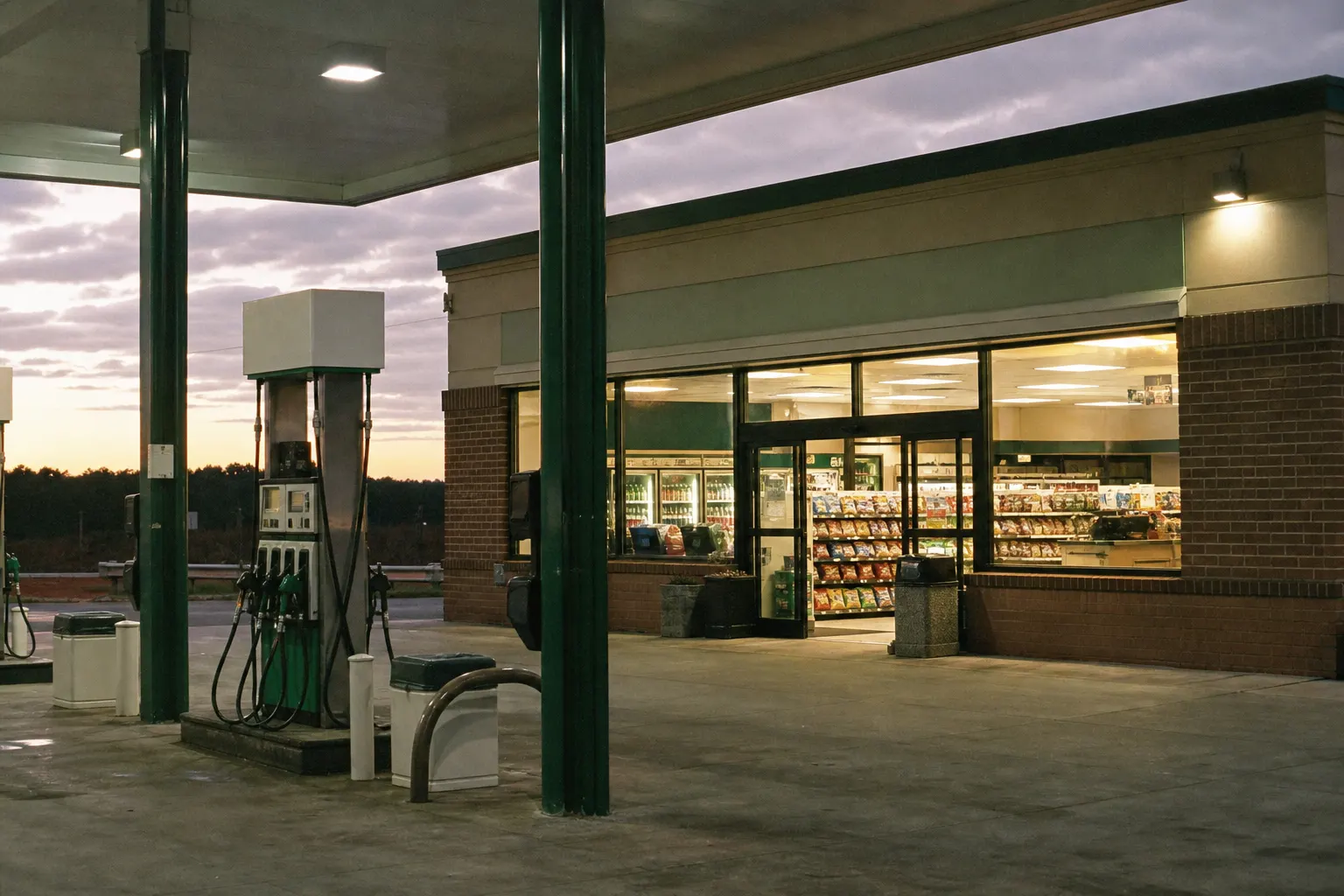
A gas station with grocery is two businesses sharing a canopy. Fuel earns in cents per gallon. The inside box earns on tobacco, packaged beverages, beer, lottery, and — sometimes — a grocery run. If you blend the deposits, you will sell a grocery story that a lender cannot underwrite. Split last month’s fuel ledger from last week’s inside scan data before you argue a multiple. Then book a confidential intro with both ledgers in the same folder.
Grocery Store Business Broker — the grocery practice of HedgeStone Business Advisors, led by Jason Taken — will package the inside going concern as an asset sale and will not pretend FMI supermarket facts price the pumps. FMI’s $1 trillion in 2025 supermarket sales, 45,575 U.S. supermarkets in 2024, and $668,377 average weekly sales per supermarket describe a grocery channel. Census NAICS 445110 excludes convenience retailers. Your site is not that sample.
Two ledgers before anyone says grocery
Start with two columns. Column one: gallons, cents per gallon, fuel brand, and the jobber or major-brand supply contract. Column two: inside sales by category — cigarettes, beverages, beer, lottery commission, foodservice if you have it, and grocery if you actually have a grocery room. SDE that mixes those columns is a rumor.
Suppose the site moves a large gallon week and the inside rings $22,000. The bank deposits look like a small supermarket. They are not. Fuel pass-through inflates the top line and hides the inside margin. A buyer who underwrites grocery SDE on fuel-inflated deposits will either walk or retrade. Read verifying sales with scan data for the inside story and evaluating a store’s P&L for how the two stories get separated.
Grocery is rarely the earnings engine on this format. A cooler wall and a short dry-grocery run can be real. They are still a c-store grocery aisle unless scan proves staple-food depth. Compare the inside box to sell a convenience store with grocery, not to sell an independent supermarket. The pumps do not make the aisle a grocery room.
Print the SDE worksheet twice if you have to: once for inside, once for a combined view you will then discard. Owner pay, a documented one-time dispenser repair, and a personal auto can move inside SDE. Recurring inside shrink cannot. Fuel margin is its own recast. Do not use grocery add-backs to clean a fuel week.
What a grocery multiple can and cannot do here
BizBuySell grocery and supermarket sold businesses: 3.38 average earnings multiple in 2025; 2.66 five-year average; IQR 1.60–3.15 for 2021–2025. A 0.43 average revenue multiple on the 2025 sold sample is a sanity check, not a pricing law. Those figures are a national listing-site grocery/supermarket sample. They are not a gas-station multiple. They do not price tanks. They do not price a brand image agreement. Apply them, if at all, to recast inside grocery-and-c-store earnings after fuel is stripped out — and even then they are a ceiling check, not a quote.
FMI’s 2.1 percent average net profit for food retailers in 2025 is a food-retailer Speaks sample. It is not a cents-per-gallon net. The valuation hub and how to value a grocery store teach grocery method. This page will not invent a fuel-site sold-comp set or a tank-replacement dollar figure. Pull the environmental report.
DSCR is annual cash flow over annual debt service. Hope is not a ratio. SBA 7(a) — the program page states a $5 million maximum — is used on change-of-ownership files that a lender will fund. Environmental and brand-supply surprises kill those files. Unreported cash will not survive SBA or a serious conventional buyer. See selling with unreported cash and conventional financing.
Related-party rent that juiced inside earnings will reverse when the buyer pays market. Pull the gap out of SDE. This page will not invent a local rent. If you own the dirt, you have a third file — grocery with real estate — and the tanks sit on that parcel.
Tanks, brand paper, and the dirt
Underground storage tanks and the environmental file can exceed the store SDE. An open LUST case is not a footnote. This page will not invent cleanup dollars. The report is the report. A buyer who understands fuel will ask for it before they ask about the grocery cooler. A grocery-only buyer who skips it is not a buyer you want in exclusivity.
Fuel brand image agreements and jobber supply often will not assign on the seller’s timeline. Sequence that consent the way you would sequence a wholesaler on a supermarket — after an NDA and a serious name, not as a vestibule announcement. Inside DSD still matters: beverages, snacks, bread, ice cream. Grocery wholesale on this format is often minimal. Read wholesaler and banner agreements for the inside book.
Owned real estate is a second asset. Recast the inside store on market rent, then price the parcel with a real-estate licensee and an appraiser who have seen tanks. Do not blend a grocery multiple and a cap rate into one invented number. Start at selling with a lease versus real estate and buying a store with real estate if you want the buyer-side mirror. A sale-leaseback is a structure, not a slogan — sale-leaseback strategy.
Jason Taken and HedgeStone are not licensed business brokers in every state. Check the rule that applies to your deal. Selling the building always requires a real-estate license.
Inside licenses still run on agency clocks
USDA FNS: SNAP authorization does not transfer; the new owner files a new application. That rule is federal. A gas-station grocery does not get a local shortcut. If the inside mix cannot support staple foods after a reset, the next SNAP retailer authorization can fail. Read what happens to SNAP when you sell. EBT deposits should reconcile to the SNAP story, not to the fuel deposits.
Tobacco, lottery, and beer sit on the inside. Lottery retailer contracts are often personal. Tobacco sits with tax and health agencies, not with the APA automatically. Beer is a class, a quota, or a control-state product. NABCA lists seventeen control states, plus additional local control jurisdictions. Read state alcohol regimes, liquor-license diligence, and transferring a liquor license. The food permit for the inside box is its own line. Print the WIC, lottery, and tobacco checklist and the closing and license checklist.
A CIM that omits the lease — or the ground lease under the canopy — is a brochure. Lease diligence is where civilians get surprised. Assignment, exclusive use, and co-tenancy still move price. Remaining term under 24 months without options is a price cut. See how a sale works.
Who underwrites a fuel-and-grocery site
Fuel marketers already split cents and inside. C-store groups know tobacco turns and lottery commission. SBA 7(a) buyers who understand environmental can close if the tank file is clean and the inside recast is honest. A grocer who wants FMI’s supermarket weekly-sales figure will waste everyone’s week. First-time buyers need how much money you need and a file a lender will fund — buying as a first-time owner.
Confidential outreach is the default: blind teaser, NDA, then a CIM for operators who can fund. Read how to sell confidentially. Employees and jobbers learn from a sign. A public listing is a last resort after you understand what it does to shrink and to the brand’s nerves.
The twin page is buy a gas-station grocery. The parent method is sell a grocery store. Download the Confidential Seller Playbook and circle the tank report you do not have. Missing paper is common. Hiding an open environmental case is how the hour dies.
Count night is fuel and inside, separately
Inside inventory at cost is a separate check: tobacco, beer, grocery, and foodservice each with an unsellable rule. Fuel in the ground is a stick reading and a rack-or-contract price, not a grocery count. Write both rules into the LOI. Read how inventory is counted for the inside room and the LOI terms that matter for sellers for the paper.
Holdbacks exist because grocery has shrink and successor tax risk, and because fuel sites have environmental tails. Earn-outs are hard because the buyer controls pricing and mix after Monday. Compare offers on cash at close, note terms, inventory treatment, tank risk, and license risk — not the headline. See comparing offers and escrow, holdbacks, and earn-outs.
Tax clearance belongs in escrow language. State bulk-sales notes still matter. Sales-tax filings corroborate inside food where it is taxed — state grocery sales tax. APA schedules are where the dispenser contract, the soda fountain, and the lottery terminal actually live. Send counsel working with attorneys and CPAs before they draft a supermarket APA onto a canopy.
What a grocery-only buyer gets wrong
A grocer who wants FMI’s $19.59 weekly sales per square foot of supermarket selling area will stand under the canopy and do the wrong math. Selling area on a fuel site includes a lot of pavement that does not ring grocery. Inside square footage is the grocery conversation. Gallons are the fuel conversation. Mixing them produces a sales-per-foot story that cannot be defended in due diligence.
The same buyer will treat fuel deposits as proof of grocery volume, then discover that inside basket size is a pack of cigarettes and a drink. That is an honest c-store. It is a dishonest supermarket. If you want grocery operators in the pool, the teaser has to say “fuel plus inside,” not “grocery store with pumps.” If you want fuel marketers, say gallons and inside mix in the first paragraph of the blind teaser.
Working capital is two stacks. Inside needs cash for tobacco and DSD. Fuel needs cash for the next load and a cushion for the environmental deductible you have not invented a dollar figure for. The cash-to-close estimator is a starting tool; it does not replace a tank report. How much money you need is the longer buyer essay. Sellers still need to know which stack the first week consumes.
Hours and crime sit on the inside P&L. A 24-hour canopy with a thin grocery run is a staffing file. Minimum wage belongs in the recast if the table moved — state-by-state minimum wage. A rural pump-and-box can be a good living and a difficult loan. Those are different questions. See sell a rural grocery only if the inside is actually a grocery room; most fuel sites are not.
Non-competes have to be enforceable and narrow. A clause that tries to ban every gallon in the county will not keep. Read non-competes and confidentiality. Transition hours on a fuel site include who is authorized on the brand’s system Monday morning, not only who can face the candy rack. Write both — transition and training. Post-closing 90-day plan is the buyer-side sequence; sellers still owe the first week.
If you want the fee conversation, how brokers get paid. If you want the slip list, common reasons grocery sales fall apart and surviving due diligence. Timelines slip on brand consent, environmental, and inventory night — timeline to sell. Seller notes often sit on standby behind SBA. Read the standby.
When both ledgers are split and the tank report is in the folder, book a confidential seller consultation. Bring the fuel supply page that says whether it assigns. Bring last week’s inside mix. That is a useful hour.
An illustrative recast on Sell a gas station with grocery
Price language for Sell a gas station with grocery is (recast SDE x a defendable multiple) + inventory at cost, plus or minus lease and license risk. The table is one consistent example for this URL.
Rent at 3.0% of sales is the occupancy check. If the real lease is higher, the SDE in this table is too generous until you recast to market rent.
Bring three years of P&Ls, weekly sales, and the lease abstract to the intro call. Jason will tell you whether this band is even in the conversation.
This page is educational information from Grocery Store Business Broker (HedgeStone Business Advisors). It is not legal, tax, or investment advice. Licensing, tax, and financing rules vary by state and deal. Confirm every item with counsel and your lender before you sign.