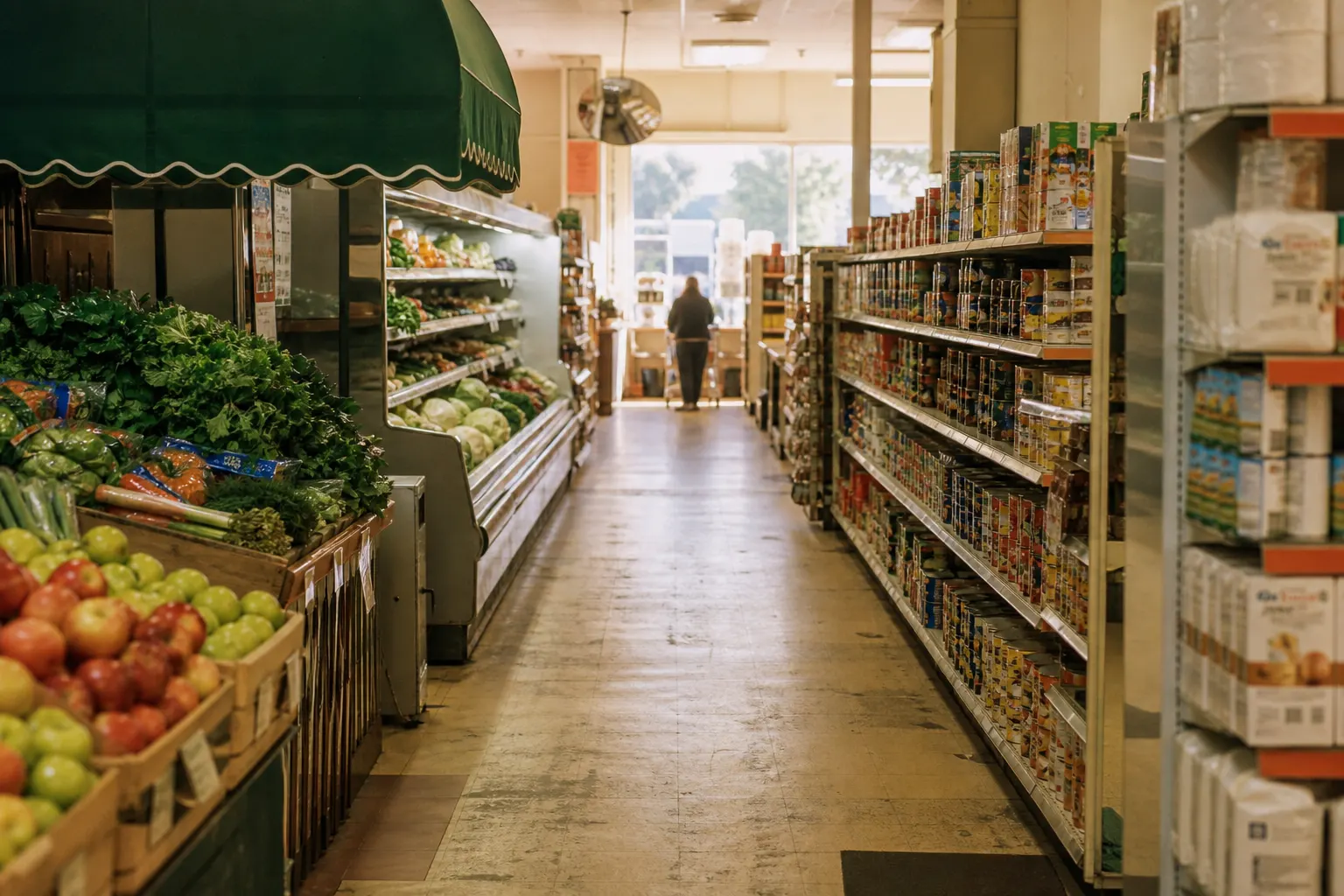
Generated illustration for this page. Not a listed store and not a photograph of a specific owner.
Banner — A store brand the independent is allowed to use, such as IGA, Piggly Wiggly, or a wholesaler private-label fascia, under a supply contract. The banner is a license in that contract, not equity in the store, and it does not move without the wholesaler’s written consent.
Shoppers know the sign. The warehouse owns the right to put it on the building. The independent pays program charges, buys a private-label book, and runs a circular the house prints. That is a contract. It is not a franchise in every case, and it is not an asset the APA can convey by naming “goodwill.” Is my wholesaler agreement transferable? is the first question. Banner versus independent is the buyer’s fork.
FMI counted 45,575 U.S. supermarkets in 2024 across conventional, limited-assortment, supercenter, warehouse, club, natural, and commissary formats. Your fascia is one contract inside that channel. It is not a multiple. A buyer who wants “the IGA sign” needs a consent letter, a credit file, and often a new personal guarantee. The seller’s handshake does not assign the mark.
Consent, credit, and the over-advance
Sequence the warehouse after an NDA and a serious buyer. Telling the house first is how the floor hears you are exiting. The wholesaler can refuse a new account, refuse to release the seller’s guarantee, or refuse banner consent even after the landlord has signed. Write consent as a close condition in the LOI.
An over-advance on the warehouse statement is a payable. The seller usually clears it from proceeds, or the buyer assumes it with a new guarantee. Do not fold it into add-backs. DSD routes need a named payer on Monday; put those accounts on an APA schedule so bread and soda do not stop because nobody signed a new house account.
The banner directory is for naming the program you actually have. Do not describe a voluntary fascia as a franchise, or a franchise as a courtesy sign.
Keeping the sign versus converting
If the buyer keeps the fascia, recast banner fees, circular charges, and program minimums as continuing costs. FMI’s 2.1 percent average net profit for food retailers in 2025 is a thin food-retailer sample. Program dollars sit on that net. They are not a one-time cleanup.
If the buyer converts, recast the lost circular, the reset labor, the new private-label hole, and the credit application at the new house. Can I convert to a new banner? and buying and converting are the path. Price the book as the store that will exist after the sign changes, not as the store in last year’s ad.
If you have the supply contract and a buyer who cares about the fascia, book the banner conversation. Bring the agreement, the last three program invoices, and the over-advance line if there is one. The hour is for consent and the recast, not for a photo of the storefront.
An illustrative recast on Banner consent when you sell a grocery
Price language for Banner consent when you sell a grocery is (recast SDE x a defendable multiple) + inventory at cost, plus or minus lease and license risk. The table is one consistent example for this URL.
Input or output
Illustrative figure
Weekly sales (illustrative)
$108,000
Annual sales
$5,616,000
Recast SDE
$325,728 (5.8% of sales)
Inventory at cost
$351,000 (~16 turns)
Occupancy check
$179,712 / year (3.2% of sales)
Low going-concern
$953,597 at 1.85x SDE + inventory
High going-concern
$1,230,466 at 2.70x SDE + inventory
Sketch DSCR on a note
1.48
Rent at 3.2% of sales is the occupancy check. If the real lease is higher, the SDE in this table is too generous until you recast to market rent.
Book the intro call with your side of the table ready: seller files or buyer capital. The calendar is the only next step.
Download the worksheets, then book the call
Print these, mark them up, and bring the marked copy to the intro. They are educational. They are not a valuation letter and not a listing.
All downloadable guides.
Confidential Seller Playbook3 pages. Recast checklist, teaser rules, license calendar, and what to bring to the first call.
Buyer Underwriting Workbook3 pages. Sales proof, shrink, rent, SNAP, DSCR, and cash-to-close math a lender will fund.
SDE Valuation Worksheet2 pages. Line-by-line add-backs, inventory at cost, and a multiple band you can defend.
Closing & License Checklist2 pages. Count night, SNAP re-application, alcohol, tax clearance, and the first 30 days.
Frequently asked questions about Banner consent when you sell a grocery
Does the seller’s banner automatically transfer at close?
No. The fascia sits in the wholesaler agreement. The warehouse must consent in writing, often with a new credit application and a new personal guarantee. The seller cannot assign the sign by handshake.
What if the buyer wants to keep the IGA or Piggly Wiggly sign?
Treat consent as a close condition. Sequence the warehouse after an NDA and a serious buyer. Telling the house first is how the floor hears you are exiting.
Do banner program charges belong in SDE?
If the buyer keeps the fascia, recast those fees and circular charges as continuing costs. If the buyer converts, recast the lost circular, the reset, and the new private-label hole.
Can a buyer convert to a different banner at close?
Yes, as a planned convert: new credit, new minimums, new private label, often a dark period on the old circular. Read the conversion path before you price the book as if the sign were free.
Start a confidential grocery conversation
Whether you are exiting or acquiring, pick a time and we will talk through the file.
This page is educational information from Grocery Store Business Broker (HedgeStone Business Advisors). It is not legal, tax, or investment advice. Licensing, tax, and financing rules vary by state and deal. Confirm every item with counsel and your lender before you sign.
Ready when you are. Jason Taken will talk through the file.