Do I need fuel experience or grocery experience?
You need both clocks. Fuel marketers already know tanks and brand supply. A grocery-only buyer who ignores environmental paper and image agreements will stall the close.
Grocery Store Business Broker · HedgeStone Business Advisors · Jason Taken
Last updated 2026-09-04
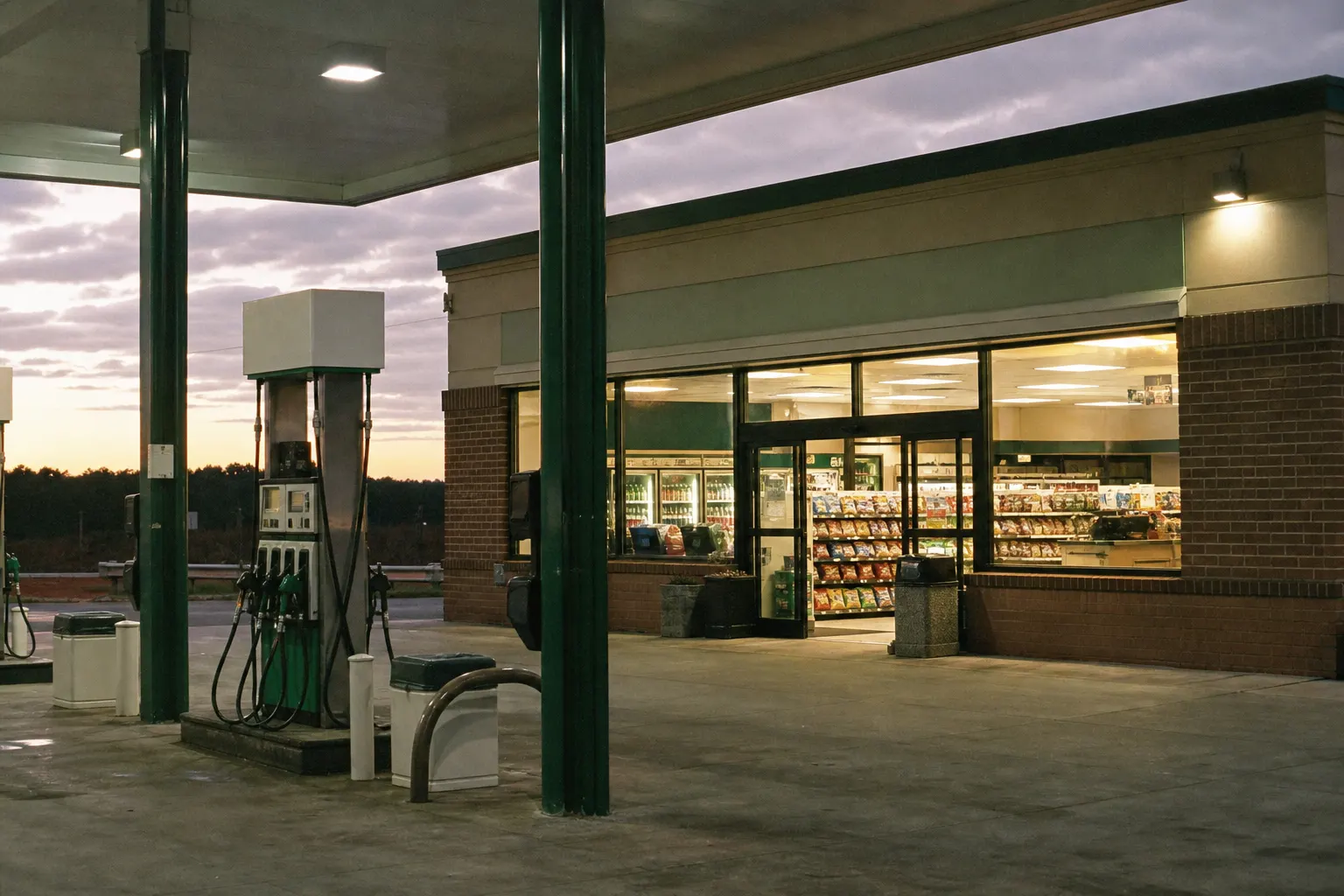
Buying a gas station with grocery is two businesses that share a driveway. The CIM will add the pumps to the coolers and call the total a grocery store. You need to know what the gallons earned, what the tanks can cost you, whether the brand will keep supplying you, and whether the inside room is a real grocery file or a c-store with a SNAP sticker. Grocery Store Business Broker — HedgeStone Business Advisors, led by Jason Taken — will not let you underwrite fuel deposits as grocery SDE. Mark the Buyer Underwriting Workbook, then book a confidential intro with the environmental file in the folder.
FMI’s $1 trillion in 2025 supermarket sales and $668,377 average weekly sales per supermarket describe a supermarket channel. They do not describe a corner with dispensers. FMI’s $19.59 weekly sales per square foot of selling area is a selling-area supermarket figure. Do not divide canopy gallons into that number and call it diligence. Census NAICS 445110 excludes convenience retailers. A gas-and-grocery site is usually that excluded world plus a fuel desk. Quote supermarket facts only as a reminder of what this file is not.
Split fuel from inside sales before you recast anything. Fuel is cents per gallon, volume, and brand. Inside is scan, mix, and shrink. A deposit total that includes gallons will make grocery look huge and grocery margin look tiny. Evaluating a store’s P&L and anatomy of a grocery P&L assume you can see departments. On this format the first department cut is fuel versus inside. The second cut is grocery versus tobacco, beer, packaged beverage, and foodservice.
Seasonality does not move both sides together. Gallon volume can spike with a highway weekend or a price war while the grocery room stays flat. A grocery-only buyer who annualizes the best fuel month will invent SDE. Ask for twelve months of gallons and twelve months of inside scan, not one blended deposit tape. If the seller cannot split them, you do not yet have a recast. Recasting a grocery P&L starts after that split, not before.
Scan data on the inside should reconcile to inside sales, not to the bank deposit that includes fuel. Verifying sales with scan data is the inside method. Fuel needs gallons, posted margin, and supplier invoices. Sales-tax filings help on the inside where food is taxed or partially taxed — grocery sales tax. A cash story with no trail is a walk. See red flags that should kill a grocery deal.
Grocery is rarely the earnings engine. That is allowed. It is not allowed to be invisible. If you came from an independent supermarket looking for a small box, you may be on the wrong driveway. If you came from fuel and the grocery room is three bays of milk and bread, treat it as a c-store accessory and read convenience-with-grocery for the mix questions. The CIM is a list of claims — how to read a CIM.
BizBuySell’s grocery/supermarket sold sample — 3.38 average earnings multiple in 2025; IQR 1.60–3.15 for 2021–2025 — does not control a fuel-and-inside site. Use it as national context on the inside book if that book is real grocery. Do not multiply a blended SDE that still has gallons in it. A 0.43 revenue multiple (2025 sold-sample average) is worse here because fuel inflates revenue. Return to a split recast. The valuation hub and multiples report are the grocery method, not a canopy quote.
Teaching example, labeled illustrative: inside recast SDE of $180,000 and fuel cash flow of $140,000 after you strip owner add-backs and leave recurring shrink in. Those are two prices. A single 2.6× on $320,000 blended is how a grocery buyer overpays for tanks they have not read. Use the SDE worksheet with two columns.
Underground storage tanks are not a grocery footnote. Open leaking-underground-storage-tank cases, tank age, monitoring, and insurance belong in the folder before you fall in love with the coffee program. This pack does not invent tank-replacement dollar figures. Pull the environmental report. If the seller will not produce it, you do not have a file. Due diligence that starts at the dairy case is in the wrong order.
Real estate and tank liability can exceed store SDE. Owned dirt with tanks is two assets plus a cleanup clock. Leased dirt with seller-owned tanks is a consent and indemnity problem. Recast the inside store on market rent if the seller’s occupancy is a related-party gift — rent checker. Then decide whether you are buying the parcel. Buying a store with real estate is the split. Do not blend a cheap canopy lease into a grocery multiple.
Lease diligence on a leased corner still includes assignment, remaining term, exclusive use, and whether the use clause allows fuel plus grocery plus beer. A remaining term under 24 months without options is a price cut, not a footnote. CAM true-ups can erase a year of “extra” SDE on a pad site.
Fuel jobbers and major-brand image agreements do not always assign. The fascia on the canopy can be the earnings. If the brand will not keep you, you are buying unbranded gallons and a different customer. Write brand consent into the LOI the way you would write a wholesaler consent on a supermarket. APA schedules should list the supply contract, the image agreement, and what happens if consent fails — asset purchase agreement essentials.
Inside DSD still matters: snacks, beverages, bread. Grocery wholesale is often thin. Confirm you can restock the grocery room after Monday. Lottery, tobacco, and beer are the inside clocks most fuel marketers already know. Lottery retailer contracts are often personal. Tobacco sits with tax and health agencies. Beer is a class, a quota license, or a control-state privilege. NABCA lists 17 control states plus local-control pockets. Read alcohol regime and liquor license diligence. WIC, lottery, and tobacco checklists belong in the same folder as the tank report.
USDA FNS: SNAP authorization does not transfer. The new owner files a new application for the inside store. That is federal. A gas station with grocery does not get a local shortcut because there are pumps outside. Read EBT / SNAP diligence and what happens to SNAP when you sell.
The grocery room has to meet staple-food depth on the mix you will actually run. If the inside box is mostly cigarettes and drinks, SNAP retailer authorization may not survive a reset. EBT deposits should reconcile to the inside SNAP story, not to fuel. A gap is mix, downtime, or fiction. Budget SNAP downtime in cash. Print the closing and license checklist.
Food permit for the inside box is a local health file. WIC is a vendor file if it exists. None of those clocks wait for tank repairs. Write license outs into the LOI so a SNAP delay or a brand refusal is an exit, not a surprise.
SBA 7(a) can finance a change of ownership; the published maximum is $5 million. Eligibility still wants a for-profit U.S. business that is small under SBA size rules, not an ineligible type, and creditworthy with a reasonable ability to repay. Environmental and brand-supply paper is how these files live or die in underwriting. Read SBA 7(a) for grocery acquisitions. DSCR is annual cash flow after an honest split recast, divided by annual debt service. Use the SBA payment and DSCR calculator. Unreported cash does not survive SBA. Fuel cash that never hit the return does not survive it either.
How much money you need is a stack: equity, inside inventory at cost, fuel inventory if you buy it, working capital for the next fuel load and the next inside drop, SNAP lag, and a reserve the environmental report can justify without inventing a tank number. The cash-to-close estimator exists so you stop using the down-payment slogan.
Teaching example, labeled illustrative: $1,200,000 for the going-concern (ex-inventory, ex-realty) at 15 percent equity is $180,000. Inside inventory at cost of $90,000 and fuel inventory of $40,000 are usually cash or short-term pieces. Add $50,000 working capital and $30,000 for closing plus SNAP downtime. You are a roughly $390,000 buyer before anyone talks about buying the dirt. If you also buy the parcel, that is a second close — grocery with real estate.
Seller carry, if any, often sits on standby. Read buying with seller financing. Conventional or credit-union paper shows up when the tanks are boring in a good way — conventional and alternative financing. Buying as a first-time owner is harder when the lender wants fuel hours someone will underwrite.
Inventory night on the inside is still a grocery count: cost, not retail tags, with unsellable rules. Read how inventory is counted and closing-day count procedures. Fuel inventory is a separate stick or book-out. Do not let one crew blend them.
Fuel marketers and c-store groups usually win because they already live in environmental, brand, and overnight labor. SBA 7(a) buyers win when they understand that the grocery room is a SNAP-and-mix file and the pumps are a different diligence stack. Grocery-only buyers lose time when they tour coolers first and discover an open LUST case in week six.
Hours are an operating requirement, not a slogan. A canopy that runs all night needs a buyer who will staff it and an insurance file that will renew. Incident logs, drive-off history, and whether you will actually stand the overnight belong in the model before you tour. A grocery buyer who wants neighborhood hours should look at a neighborhood grocery instead of hoping the pumps will fund a shorter day. Competition and trade-area math on a corner is gallon leakage to the next branded site, not a ZIP-code story about supermarket weekly sales.
Wage is a model input on long hours. State minimum wage belongs in labor before you staff a 24-hour canopy. FMI’s 2.1 percent food-retailer net in 2025 is a supermarket-channel reminder, not a fuel-margin quote. Your recast is allowed to be better or worse. It is not allowed to hide gallons inside grocery SDE.
Compare the twin sell page for the seller’s incentives. A fuel-less convenience store with grocery is the sibling without tanks. Start from the buyer hub and how to buy a grocery store step by step. Surviving due diligence is the calendar after the LOI.
Post-close, keep the jobber paid, keep inside DSD paid, re-file SNAP immediately, and hold the seller to transition hours on both the console and the grocery room. Read the post-closing 90-day plan and transition and training periods. Attorneys who have never closed fuel-plus-grocery will treat tanks as a Phase I footnote and SNAP as a grocery footnote — bring them working with attorneys and CPAs. Shrink, margin, and turns still apply inside; inventory turns on cigarettes and milk are not one clock.
When the workbook is marked and the environmental report is in the folder, schedule the buyer strategy call. Bring proof of funds, the split recast, and the brand-supply question you cannot answer yet. Jason Taken would rather walk tanks on that hour than watch a grocery buyer discover them after the LOI.
These figures are a teaching walk-through for Buy a gas station with grocery, not a quote and not a sold comp. Order of operations: weekly sales, recast SDE, inventory at cost, then a multiple band.
| Input or output | Illustrative figure |
|---|---|
| Weekly sales (illustrative) | $78,000 |
| Annual sales | $4,056,000 |
| Recast SDE | $125,736 (3.1% of sales) |
| Inventory at cost | $289,714 (~14 turns) |
| Occupancy check | $89,232 / year (2.2% of sales) |
| Low going-concern | $522,326 at 1.85x SDE + inventory |
| High going-concern | $629,201 at 2.70x SDE + inventory |
| Sketch DSCR on a note | 1.31 |
If weekly sales or shrink move 8 percent, the SDE and the note move with them. That is why Jason Taken starts with scan data and the lease, not with a neighbor's rumor multiple.
Bring proof of funds or a lender pre-screen, your format, and geography. Jason will tell you whether a store like this can clear SBA or seller-carry math.
Print these, mark them up, and bring the marked copy to the intro. They are educational. They are not a valuation letter and not a listing. All downloadable guides.
Have the file ready so the hour is a recast, not a scavenger hunt. Then pick a time.
Underwrite the deal before you fall in love with the store
Scan data, SNAP mix, rent-to-sales, and DSCR. If those four do not clear, the CIM photos do not matter.
Schedule a Buyer Strategy CallYou need both clocks. Fuel marketers already know tanks and brand supply. A grocery-only buyer who ignores environmental paper and image agreements will stall the close.
SBA 7(a) can finance a change of ownership; the published maximum is $5 million. Environmental and brand-supply files still have to be a story a lender can defend.
Split gallons from the inside book before you touch a supermarket multiple. Fuel brand consent and tank liability are not grocery SDE — price them on their own paper.
No. USDA FNS: SNAP authorization does not transfer; the new owner files a new application for the inside store. Fuel brand consent is a different clock. Book a confidential intro to split those two files.
Pull the tank and environmental reports; do not invent replacement dollars. Realty and tanks only belong in the deal if that math stands alone after you recast the inside store on market rent.
Source and finance a grocery acquisition
Jason Taken works buyers through qualification, SBA or seller-carry structure, and a diligence plan a lender will fund. Book the hour.
Schedule a Buyer Strategy CallThis page is educational information from Grocery Store Business Broker (HedgeStone Business Advisors). It is not legal, tax, or investment advice. Licensing, tax, and financing rules vary by state and deal. Confirm every item with counsel and your lender before you sign.
Ready when you are. Jason Taken will talk through the file.
Book a confidential intro