How far is a grocery trade area?
Far enough that you have driven it at the hours this store actually trades. A copied 1-/3-/5-mile ring is a starting map, not diligence. Neighborhood boxes live shorter. Rural boxes live longer. Write what you saw.
Grocery Store Business Broker · HedgeStone Business Advisors · Jason Taken
Last updated 2026-09-04
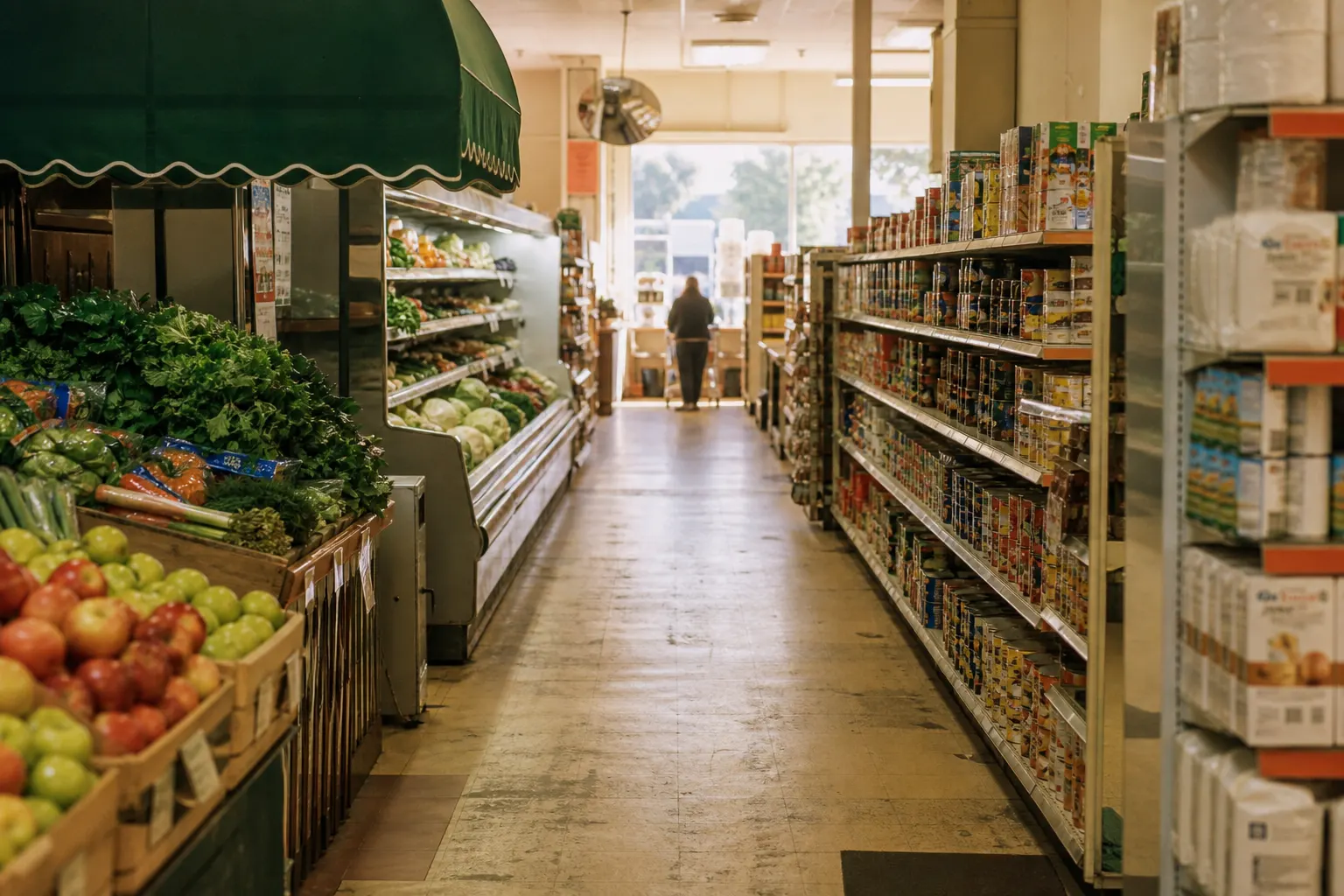
Drive the ring. Banner density and parking beat a radius printout. Grocery Store Business Broker — the grocery practice of HedgeStone Business Advisors, led by Jason Taken — will not underwrite a grocery from a demographic PDF you did not walk. If you came here with a 3-mile ring and a hope, keep reading. Then get in the car.
FMI sized supermarket sales at $1 trillion in 2025 and counted 45,575 U.S. supermarkets in 2024. $668,377 average weekly sales per supermarket and $19.59 weekly sales per square foot are channel samples. They describe the supermarket industry, not what this intersection can support. Use them on the industry outlook and the KPI-by-format guide. Price this scan. Start at the buyer hub for the purchase sequence. This essay is how competition shows up in a file a lender will fund.
A copied 1-/3-/5-mile ring is a starting map. It is not the trade area. Neighborhood boxes often live inside a walk and a short hop. Rural boxes live along a highway and a school-run. Urban ethnic stores live on a corridor that a radius will cut in half. Write what you saw, not what the software defaulted.
Go at open, on a weekday mid-afternoon, and on Saturday. Count cars. Count baskets leaving. Read the hours on every competing door. A limited-assortment banner that closes at 9 p.m. is a different rival than a 24-hour supercenter. A dollar store that is busy at 11 a.m. is taking center-store trips while your independent is resetting produce. Photograph the parking field. A full lot with no cart corrals and a choked entrance is a capacity story. An empty lot at 5 p.m. is a mix story. Neither is a slogan.
Talk to the lot, not the seller’s cousin. Watch whether shoppers walk from a bus stop, a clinic, or a church. Watch whether they leave with meat and produce or with a bag of chips and a soda. Perimeter trips are why independents still earn a living next to cheaper center store. Center store is the aisle dollar stores and e-commerce leak first. If the perimeter is weak, the grocery is a large convenience store no matter what the banner says.
Language on the floor is part of the ring. A Hispanic grocery whose counter cannot speak the shopper’s language will leak to the operator who can. The same is true for Asian, Indian, halal, and Caribbean or African files. Buying an ethnic market outside your community is a staffing plan, not a demographic printout. Read buying an ethnic market outside your community.
Count banners that take the same basket. Do not count every food door. A club membership warehouse 11 miles away may take the big freeze trip and leave the fill-in trip. A limited-assortment box a mile away takes the milk-and-eggs run. A dollar store takes paper and snacks. A national specialty banner takes the organic ring. A new full-line independent takes everything if it parks better. Walk each one with a basket in your head: where would this shopper go on Tuesday at 5:40 p.m.?
This pack does not invent a “number of competitors” rule or a sales-transfer percent. Do not write “the new box will take 18 percent.” You do not know. You can write: the new banner is announced, the pad is graded, the hours will overlap, and last year’s scan already shows center-store softness. That is a recast conversation. See evaluating a store’s P&L and shrink, margin, and turns.
A dollar store already open or announced is a red flag on rural files if you confirm it. It is not an automatic kill on a store that still owns meat and produce. Do not invent a dollar-store discount to SDE. Recast mix. Ask whether the wholesaler minimum still clears if center store keeps leaking. See rural grocery.
National specialty banners nearby cap a natural store harder than a conventional competitor would. Salvage and discount boxes compete on price and dating, not on a supermarket circular. Gas-and-grocery sites compete with other fuel marketers. Do not mash those rings into one “grocery competition” paragraph. Format pages exist so you stop blending.
Food-desert rhetoric does not replace a P&L. HFFI and state healthy-food programs change; do not quote a stale dollar cap. If access is thin, read buying in a food desert and still recast the week. This pack does not invent a scarcity premium for being the only store in town. A rural box can be a good living and a terrible loan. Those are different questions.
The lease is part of the ring. Exclusive use may block another grocery in the center — or it may be written so poorly that a limited-assortment banner still opens. Co-tenancy may let you pay less if the anchor goes dark, or it may let you terminate. Remaining term under 24 months without options is a price cut, not a footnote. Assignment still has to be granted. Read lease diligence. A pretty trade-area map does not move a landlord.
Hours are a competitive weapon you can verify in one evening. If every rival is closed Sunday morning and this store is open, that is a trip you can keep — until a new banner copies it. If this store closes at 7 p.m. and the supercenter does not, you are conceding the after-work basket. Recast labor if you plan to extend hours. Labor follows the state minimum-wage table. FMI’s 2.1 percent average net profit for food retailers in 2025 is a Speaks sample. It will not pay the extra closer.
The mix the neighbor cannot copy is usually people: a butcher, a produce manager who speaks the corridor, a deli that actually sells lunch. Key-person risk is a trade-area fact. If the owner is the ring, write a transition that keeps them on the floor. See transition and training. Ethnic mix without language is a shrink plan. Read shrink.
Scan data is how you test the story. Department mix should match what you saw in the lot. EBT share should match the neighborhood you drove, not a speech about “working families.” USDA FNS: SNAP authorization does not transfer. A busy ring does not keep EBT on the seller’s permit. Budget downtime. Read SNAP when you sell even if you are the buyer. EBT diligence is the matching work.
Alcohol can be a competitive fence. A quota license or a control-state limitation changes who can sell what. NABCA lists 17 control states. Do not assume the rival’s beer cave is a privilege you can copy. Read liquor diligence.
The math that belongs is simple and labeled. Last week’s sales times 52. A recast margin you can defend. Occupancy from the lease as a percent of this sales, not a national slogan. Inventory at cost from a department estimate. A going-concern multiple inside the BizBuySell grocery IQR unless the lease or a real new competitor forces you lower. BizBuySell grocery/supermarket sold businesses: 3.38 average earnings multiple in 2025; 2.66 five-year average; IQR 1.60–3.15 for 2021–2025. The 0.43 average revenue multiple on the 2025 sold sample is a sanity check. Revenue multiples hide rent and labor. Return to SDE. Read how to value a grocery store.
A teaching file — not a quote. Scan $118,000 in a normal week. Annualized $6.14 million. Recast SDE 3.0 percent after market rent is about $184,000. Inventory at cost $165,000. A 2.1× going-concern line is $386,000 before stock. If a graded pad across the highway is a confirmed full-line banner, you are not in the high end of the IQR because a radius map said “underserved.” You are in a hold, a discount, or a walk. See red flags that should kill a grocery deal.
DSCR is annual cash flow over annual debt service. SBA 7(a) can finance a change of ownership; the published maximum is $5 million. A lender will still ask who else takes this basket. Experience still matters. Read SBA 7(a) for grocery and how much money you need. Working capital is the cash to buy the next load while you learn the ring. Use the cash-to-close estimator.
Non-competes should reflect the actual trade area of this box, not a copied twenty-five-mile industrial clause. A neighborhood store does not need a county-wide radius to be useful. A rural store may need the next town. Write what you drove. See non-competes and confidentiality.
Unreported cash does not become more believable because the lot looks busy. Serious buyers and SBA will not pay for cash that never hit the bank. See selling with unreported cash if the seller is telling that story.
Write a one-page ring memo. Banners you walked, hours, parking, and what basket they take. Pads graded or announced, with a date you verified. Lease exclusive-use and co-tenancy in one sentence each. Department mix from scan in one sentence. EBT share. Language on the floor. Then the recast. That page is the trade-area file. A 40-page demographic appendix without the drive is a brochure.
Verify a “coming soon” the way you verify a week. Building permit. Graded pad. Banner job posting. A rumor at the Rotary is not a competitor. A poured slab with a named limited-assortment fascia is. Write the date you saw it. If you cannot verify, say “unconfirmed” and do not haircut SDE on a ghost. If you can verify, recast mix and ask whether the lease exclusive-use even applies to that format. Some exclusive-use clauses stop a “supermarket” and still allow a dollar or a club.
Online grocery and delivery apps take trips the parking lot will not show. You will not get a clean transfer percent from this pack. You can ask whether this store already packs orders, whether those orders scan in the mix, and whether a rival is advertising same-day from a nearer box. Put that in the memo as an operator fact, not as a national e-commerce statistic this research file does not carry.
Bring photos. A credit committee has not driven your ring. A Saturday photo of a choked lot and a Tuesday photo of an empty produce wall teach faster than a radius chart.
Say in one sentence why you want this box. Fill-in trips. A corridor you already shop. A rural living. A first store next to a store you own. Then say what you did not drive. Missing a Saturday visit is common. Skipping the new pad is how the hour dies.
Print the SDE worksheet. Mark occupancy and related-party rent. Print the closing and license checklist if SNAP or alcohol will decide the Tuesday. Read how to buy a grocery store and how to read a CIM. The twin seller question on a full-line box is buy an independent supermarket.
Jason Taken will recast trade-area math in that order: what you drove, weekly sales you can prove, SDE a lender will believe, inventory at cost, then the clocks. Bring photos of the lot if that is all you have. Bring last week’s scan.
Book a confidential intro. The ring is a drive. The price is a recast.
These figures are a teaching walk-through for Competition Analysis and Trade Area Math, not a quote and not a sold comp. Order of operations: weekly sales, recast SDE, inventory at cost, then a multiple band.
| Input or output | Illustrative figure |
|---|---|
| Weekly sales (illustrative) | $168,000 |
| Annual sales | $8,736,000 |
| Recast SDE | $270,816 (3.1% of sales) |
| Inventory at cost | $728,000 (~12 turns) |
| Occupancy check | $235,872 / year (2.7% of sales) |
| Low going-concern | $1,269,632 at 2.00x SDE + inventory |
| High going-concern | $1,540,448 at 3.00x SDE + inventory |
| Sketch DSCR on a note | 1.46 |
If weekly sales or shrink move 8 percent, the SDE and the note move with them. That is why Jason Taken starts with scan data and the lease, not with a neighbor's rumor multiple.
Bring proof of funds or a lender pre-screen, your format, and geography. Jason will tell you whether a store like this can clear SBA or seller-carry math.
Print these, mark them up, and bring the marked copy to the intro. They are educational. They are not a valuation letter and not a listing. All downloadable guides.
Have the file ready so the hour is a recast, not a scavenger hunt. Then pick a time.
Underwrite the deal before you fall in love with the store
Scan data, SNAP mix, rent-to-sales, and DSCR. If those four do not clear, the CIM photos do not matter.
Schedule a Buyer Strategy CallFar enough that you have driven it at the hours this store actually trades. A copied 1-/3-/5-mile ring is a starting map, not diligence. Neighborhood boxes live shorter. Rural boxes live longer. Write what you saw.
It pressures center store. It does not automatically kill a perimeter that still earns meat and produce trips. Recast mix and shrink. Do not invent a dollar-store discount to SDE.
No scarcity premium is sourced in this pack. Price recast SDE, inventory at cost, and the lease. A one-store town can still be a difficult loan.
No. $668,377 average weekly sales per supermarket in 2025 is a channel sample. Use this store’s scan, then drive who actually shares those trips.
Count banners that take the same basket, not every food door. Clubs, limited-assortment, dollar, ethnic specialists, and a new full-line box are different threats. Walk them.
No. USDA FNS: SNAP authorization does not transfer. A busy ring does not move that rule.
Source and finance a grocery acquisition
Jason Taken works buyers through qualification, SBA or seller-carry structure, and a diligence plan a lender will fund. Book the hour.
Schedule a Buyer Strategy CallThis page is educational information from Grocery Store Business Broker (HedgeStone Business Advisors). It is not legal, tax, or investment advice. Licensing, tax, and financing rules vary by state and deal. Confirm every item with counsel and your lender before you sign.
Ready when you are. Jason Taken will talk through the file.
Book a confidential intro